Silverball guide · Batman: The Dark Knight
Everything here is a multiplier
An ordinary looking Stern with one unusual idea: you can double a feature for a whole ball before you even launch, double a shot on top of that, and the two stack.
The decision you make before the ball is in play
There are three lights in the plunger lane: Joker, Scarecrow and Batmobile. Which one you take is decided by your timing on the launch, and whichever you take is doubled for the entire ball.
Take the third light and you get double bonus as well, which doubles the whole end of ball total. Most players never notice this is a choice, and it is the single cheapest thing on the machine.
Mini mines, which is the game's real name for shot multipliers
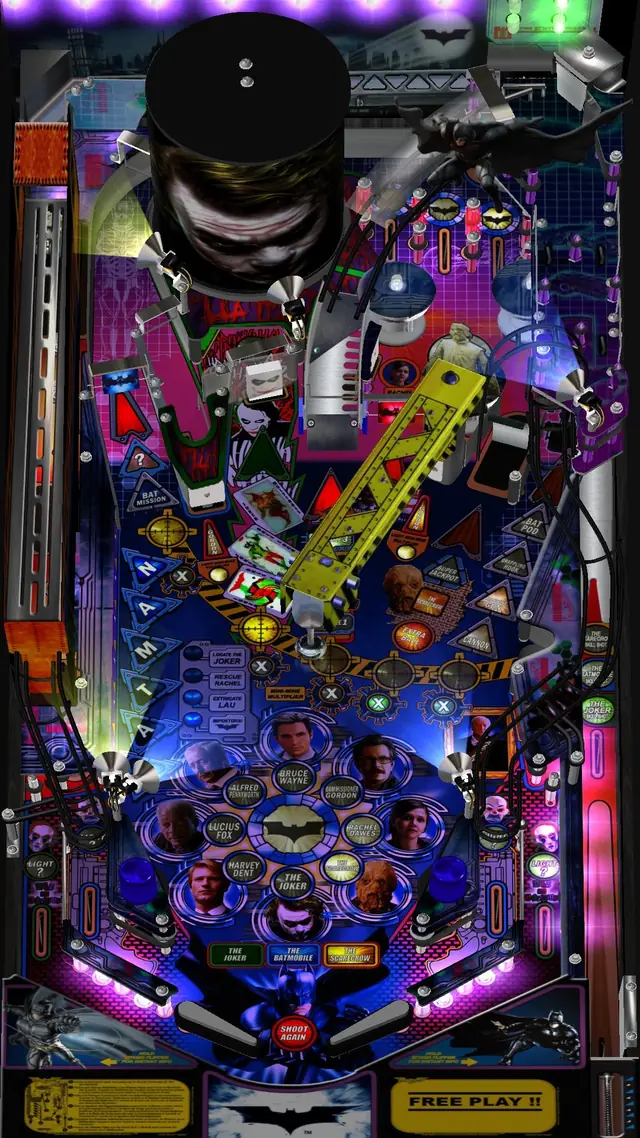
There are two Gordon standup targets, one between the left loop and the Joker, one between the right loop and Scarecrow. Hitting either moves the mini mine light to the other one. Hit the lit one six times and the multipliers come on.
The next of the five main shots you make, meaning the two loops, Scarecrow, the Joker or the ramp, is then doubled for the rest of the ball, and an X light stays on to remind you which. Light all five and the one you choose is trebled instead.
The other route in, and why the lanes matter
The Mystery, the question mark at the left loop, also awards shot multipliers. It is lit by completing the inlane and outlane lights, so those lanes are worth deliberately finishing rather than treating as what happens between shots.
The honest caveat is that Mystery only pays a multiplier about one time in four. It is a supplement to the Gordon targets, not a replacement for them.
Stacking, which is where the score comes from
The two multipliers are independent, so they multiply each other. Pick the Joker in the plunger lane, then put a shot multiplier on the Joker, and every Joker shot is worth four times its value, jackpots and super jackpots included.
That is the plan for the whole game in one sentence: choose a feature at the plunger, then spend the Gordon targets on the same feature.
The left loop is the most important shot on the playfield
It holds the Mystery, it has a spinner in it, and it ends in a saucer in the upper right that starts the Bat Missions, the Bat Signal Challenge and eventually the wizard mode. The saucer then ejects into the bumpers.
It is also a shot that rattles and bounces out of the saucer on plenty of machines, so do not read a rejection as your mistake.
The three features
The Joker has a drop target, standups behind a one way gate, and a small area that holds a ball briefly for his multiball before feeding it to the left loop and on into the bumpers.
Scarecrow is a hole and the large crane above it. The crane wants you to hit the ball on its end in each of five positions, each marked by a crosshair light on the playfield. Be careful with it: the crane's ball can block your shot, and it can send yours straight down the middle.
The Batmobile is the centre ramp. Two shots in every three send the ball to the mini playfield on the right, and the third sends it left to the see saw, which starts the Batmobile hurry up. Playfield lights tell you which is coming, so you always know where the next ramp shot is going.
What the mini playfield is for
The mini playfield above the right loop is where Batgadgets are collected. The gadgets do nothing by themselves, which is easy to mistake for the feature being pointless, but they are what you need for Lucius Fox, and two of them light an extra ball.
It returns the ball to the right inlane, and the see saw returns it to the left, so on either one you have a moment to kill the inlane light you were saving.
Missions, and the ball you get for free
The B-A-T-M-A-N standups above the left slingshot light the Bat Missions at the left loop. You only have to start all four missions, not finish them, to collect Bruce Wayne.
Alfred is a standup lit by the top lanes, and his best use is simple: he adds a ball during any multiball, once. Light him before the multiball rather than during it.
Where to start
Finish the inlane and outlane lights whenever they are close, work the Gordon targets between shots rather than as a trip of their own, and pick your feature at the plunger every single ball.
Then shoot the left loop. Almost everything the machine wants to give you is either in it or behind it.
Where this came from
Silverball wrote this, but not from scratch: it was compiled against the published rules below and checked against them, rather than written up from one person’s games. None of the wording is theirs. Machines get code updates that move the right shot, so a guide has a date on it for a reason.
- Batman: The Dark Knight rule sheet, by Daniel Bradford and Michael Spiegel, from Spiegel's original German sheet