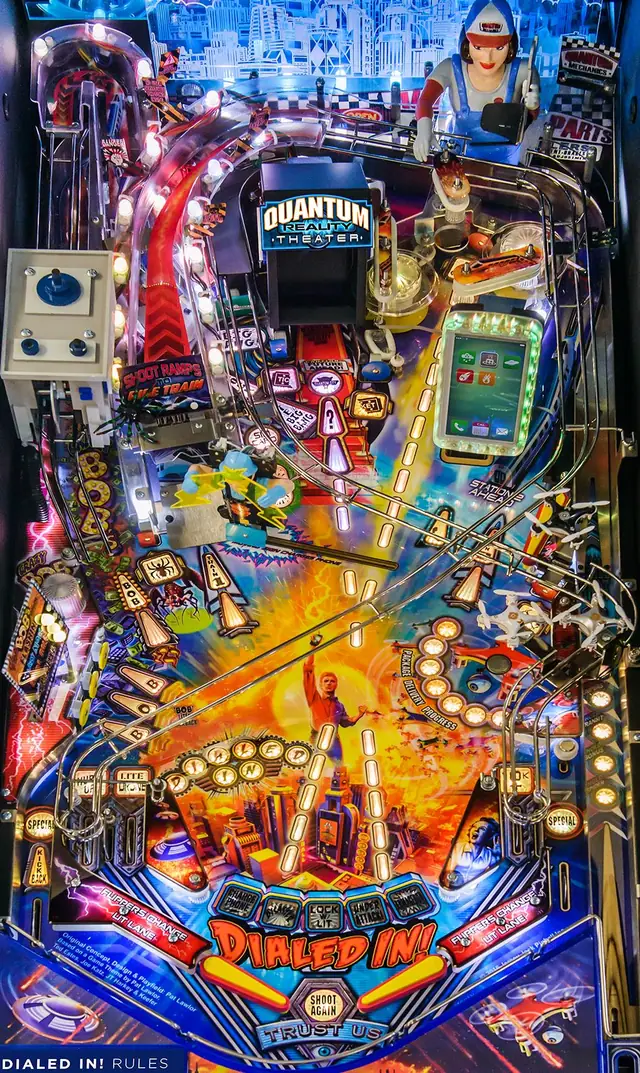
Silverball guide · Dialed In!
Collect the SIM cards before you play the modes
A SIM card multiplies the total of every mode you play afterwards, not the one you just finished. Collect them early and the same modes pay several times over. Leave them lit at the end of a ball and they are gone.
What a SIM card actually does
Completing a disaster mode lights a SIM card, and so does finishing the requirement of a quick multiball. You collect it at the side scoop.
It does not multiply the shot you are hitting. It multiplies your total from every mode after it: the sum of the mode's shot values plus the completion bonus, paid out as the mode ends. So two cards collected on ball one are worth far more than two collected on ball three.
And the way to lose them
A lit SIM card that you do not collect before the end of the ball is lost on default settings. There is no carrying it over.
Cards can be stacked for collection during a ball, and only one of the D-I-A-L-E-D-I-N lights blinks at a time, which makes it easy to think you have collected them all when you have not. Eight of them qualifies the Showdown wizard mode.
The phone's charge is your mode's score
Modes are started at the phone scoop, and mode scoring is set by how charged the phone is at the moment you start. It powers up to a hundred per cent, and every QED shot while it is lit overcharges it by another ten.
That number is shown, small and red, in the corner of the phone display. Starting a mode without overcharging first is the most common way to waste a good ball here.
You choose which disaster you get
There are eleven disaster modes, shown as city blocks, plus a twelfth block for the wizard mode. Qualifying costs QED shots, one for the first mode and rising to four as you play more.
The next mode cycles through the available icons on the phone with either flipper, so you can pick. During a mode, the first phone scoop shot after any lit shot adds time. Three modes played lights an extra ball.
Big Bang is a mode-completion button
Hit the Light Big Bang targets enough times, three at first and rising to six, to light Big Bang. What it awards depends entirely on what you are in the middle of.
In a disaster mode it instantly scores every remaining shot and completes the mode, lighting a SIM card. In a multiball it collects every lit jackpot. In both at once it does both. Outside either it is worth fifty thousand, which is nothing, so hold it.
The catch with using it
Insta-completing a mode with Big Bang does not apply your SIM card multiplier to the shots you never made, only to the ones you had already hit.
So Big Bang is best spent on a mode that has gone wrong, or on a multiball with everything lit, rather than on a mode you were about to complete anyway.
Hurry-ups you can move
The inlane hurry-ups are lit from the start of the game and are relit at any time by completing the two TICKET standup targets in front of the theatre. The flipper button moves which inlane is lit, so you can set them up for the side you expect the ball to return on.
Running a lit left inlane starts a countdown to collect at the theatre; the right inlane sends you to the left ramp instead, and successful collections raise the value. Tickets both qualify the theatre hurry-up and increase what it pays.
The crazy modes
Three of them, and they are exactly what they sound like. Emoji Overload wants the two ramps and the phone scoop, Selfie is a straight frenzy where every switch scores, and Lottery Frenzy has you shoot the ticket in the theatre and then wave at the camera to scratch the card.
Like the quick multiballs, the crazy modes allow modes to be qualified and started inside them, which is the reason to care about them at all.
The quick multiballs stack, the big one does not
Drones Gone Wild, High Voltage and Quick Monkey Wrench each stack with Under Attack Multiball in either order, and modes can be qualified and started during any of them.
Under Attack does not allow that. So if you want a mode running inside a multiball, the quick ones are the vehicle. Each also lights a SIM card for its own requirement, which is the fastest way to bank cards early.
Drones, and the award to hope for
Drone deliveries come two at a time from the drone standup and one at a time from the drone rubber. A full set lights a drone mystery at the theatre, and it carries between balls.
There is a shortcut: run a lit inner left inlane and hit the drone target immediately for a drone combo, which lights the mystery straight away. Among the awards, holding your held values is the one experienced players are hoping for.
Combos, quietly
Combos link the orbits, the ramps and the phone, building while you keep the chain going and resetting when you break it. Yellow blinking arrows show you what continues it.
Their cumulative value pays in the bonus, and a skill shot can hold that value into the next ball. Extra balls arrive at thirty five combos and again at a hundred, which is the sort of target that only matters if you know it is there.
Where this came from
Silverball wrote this, but not from scratch: it was compiled against the published rules below and checked against them, rather than written up from one person’s games. None of the wording is theirs. Machines get code updates that move the right shot, so a guide has a date on it for a reason.
- Dialed In! rule sheet (author not recorded in our copy)