Silverball guide · Jack-Bot
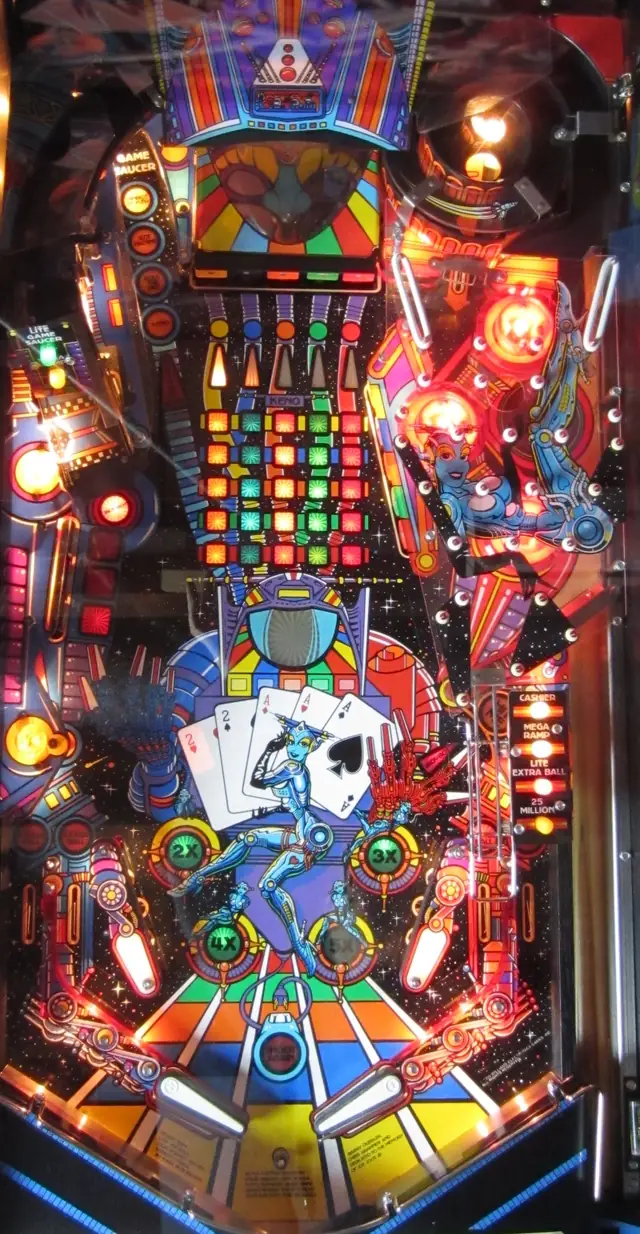
One target can fill the whole Keno card
Filling the Keno card to open the Visor normally takes between five and fifteen target hits. At the start of every card the machine offers to do it in one, and then pays you fifty million for noticing.
The flashing row is a free Visor
At the start of each Keno card, before you have hit any of the targets, the machine flashes one row or column at a time: the rows from the bottom up, then the columns from the left, then round again. Hit the target belonging to the flashing row or column and the entire card completes at once, the Visor opens, and it pays 50M.
That is the difference between one shot and fifteen. The first card of a game is cheap anyway, because until you have played a multiball each Visor target lights its whole column and five hits finish the job. It is the second card onwards where this matters: from then on a Visor target lights only the bottom two unlit lights in its column and a row target the leftmost two in its row, so the card costs thirteen to fifteen hits done the hard way.
There is a catch, and it is worth knowing before you rely on it. Once the machine starts asking for a card per ball, which happens after the second multiball, the second card of a ball has no flashing row at all. That one you have to earn.
Bank the ball off the row targets
When you do have to fill a card the long way, the shot is not a clean one at a single target. From the left flipper, bank the ball off the row targets and into the Visor targets: the ball rattles around the two banks, and because the machine counts multiple target hits from the second card onwards, one good shot can register seven or eight of them. The source reports whole cards filled in three shots this way.
Hitting a target whose row or column is already full is wasted, so the ricochet is not just faster, it is also less wasteful than picking targets off deliberately.
Jack*bots, and the one-second trick that triples them
Completing the card opens the Visor and exposes the two Eyes. Lock a ball in each and multiball starts. During it, Jack*bots are lit at both Eyes, at the Cashier target and at Hit Me. The first Jack*bot of a game is 50M and each one after adds 25M, so the eleventh is 300M; from there they climb 50M at a time to a fifteenth and final one worth 500M.
Collecting one unlights that place, and the Game Saucer relights all four, or scores a Jack*bot itself if all four are already lit. The trick worth practising is this: collect a Jack*bot at one Eye and hit the other Eye within a second, lit or not, and it scores a Super Jack*bot at triple value. At the top of the ladder that is a billion and a half points from two shots.
If a multiball ends without a single Jack*bot scored, there is a ten-second restart at the Eyes or the Game Saucer, once per multiball.
Mega Visor is the reward for fifteen
Score all fifteen Jack*bots with the multiball still running and the Visor closes for Mega Visor. Only the Visor targets count now, each hit spotting one light in its column and paying 50M, and twenty-five hits are needed. That is 1.5 billion points on the way through.
The source is honest that it never found out what happens at the end of it, and this guide is not going to invent an answer.
Cheating is a rule, not an exploit
The other half of the machine is the four casino games, started at the Game Saucer, with the left flipper choosing which one is lit before you shoot. Trap on the right flipper and pick deliberately.
At every game's title screen, hammering the Extra Ball button makes Pinbot cheat for you, and the games differ in how well it works. Roll the Dice is the easiest, flicking both dice to twelve, which matters because that game pays your dice wager times the roll. Pinbot Poker is nearly as easy, producing an extra ace and the otherwise impossible four aces for 149M. Keno is moderately hard, slamming the whole card for 99M plus 25M per card already filled. The Slot Machine is the hardest, turning a weak award into Extra Ball Lit, which the source says almost never appears honestly.
You can cheat on the bonus count too. Hit the Extra Ball button while the bonus is totalling and Pinbot may add a multiplier, taking you to 6x, but only if your multiplier is already at least 2x.
Double or nothing, and when to take it
After a casino game scores, the machine offers double or nothing. Do nothing and you keep the value. Take the right flipper and you have about twenty seconds to hit the Cashier target for double, and nothing at all if you miss. Starting multiball before the timer expires also collects the doubled value, which makes the gamble much better when you are already close to a multiball.
Playing all four games lights Casino Run at the Game Saucer without needing to relight it.
Casino Run: a bank you can lose entirely
Casino Run is a single ball on a forty-five second clock. Your bank starts at 100M and every switch adds 4M, so the bumpers pay while the clock runs. Each shot to a hole, either Eye or the Game Saucer, spins three reels, and each reel gives its own award.
After every spin you choose: take the bank and end the Run, or spin again. Take too long deciding and the machine banks it for you. The reels pay points from 15M up to 150M, extra balls, specials, poker cards, Vortex awards and more time. They also contain a Bomb, which destroys the bank and ends the Run outright.
Two things save you from a bomb. A No Bomb award, which is a bucket of water and cancels one. And the Extra Ball button again: hammer it while the reels spin and Pinbot may knock the bomb aside, though only on the centre reel and, in the source's experience, only once per Run.
Draining during the Run is survivable. The ball comes back at the plunger for five seconds off the clock, and with at least ten seconds left a made skill shot adds another ten. With nine or fewer, the skill shot banks your money and ends the Run instead. A ball sitting in a lock is a mixed blessing: it blocks a spin shot, but draining while it is there costs no time and gives you a free spin.
Know the Casino Run Champion score
There is a separate high score for Casino Run Champion, defaulting to a billion, and taking it awards a credit. The practical advice follows directly: know what the number is on the machine you are playing, and when your bank passes it, count the credit as part of the bank and take the money.
The bits that quietly add up
The ramp leads into a maze of posts, and while the ball is in there the skill shot value climbs 1M every two seconds, up to 8M a trip and a ceiling of 50M. The ball then leaves by one of three routes: into the bumpers, which starts Solar Jets and gives you twenty seconds to hit the Cashier for a value starting at 40M; to the plunger for another skill shot; or to the return lane, which pays whichever of four awards is lit as it arrives. Mega Ramp is the one to hope for, because collecting it freezes the return lane award on Mega Ramp again and the ramp pays 50M, then 75M, then 100M.
Hit Me deals blackjack cards and pays 1M per point in your hand, 50M for exactly 21, and nothing for a bust. The Poker targets advance the bonus multiplier, but only if you hit the lit one first; hit an unlit target and you lose the chance until the bank resets. Get the other two before it resets and you are spotted a poker card.
The end-of-ball bonus is 3M per card collected, plus the current skill shot value, plus your dice wager, all multiplied. Which is why the dice wager and the Vortex are worth more than they look.
A note on this source
This was compiled from a community rules sheet whose author is not recorded in our copy. It is a document written while the machine was current, and it is candid about its own gaps, including never having got past Mega Visor. Those gaps have been left as gaps here.
It also describes a Casino Run award giving hints towards a code in another machine of the period. That is left out as a curiosity rather than a rule.
Where this came from
Silverball wrote this, but not from scratch: it was compiled against the published rules below and checked against them, rather than written up from one person’s games. None of the wording is theirs. Machines get code updates that move the right shot, so a guide has a date on it for a reason.
- Jack*Bot rules sheet (author not recorded in our copy)