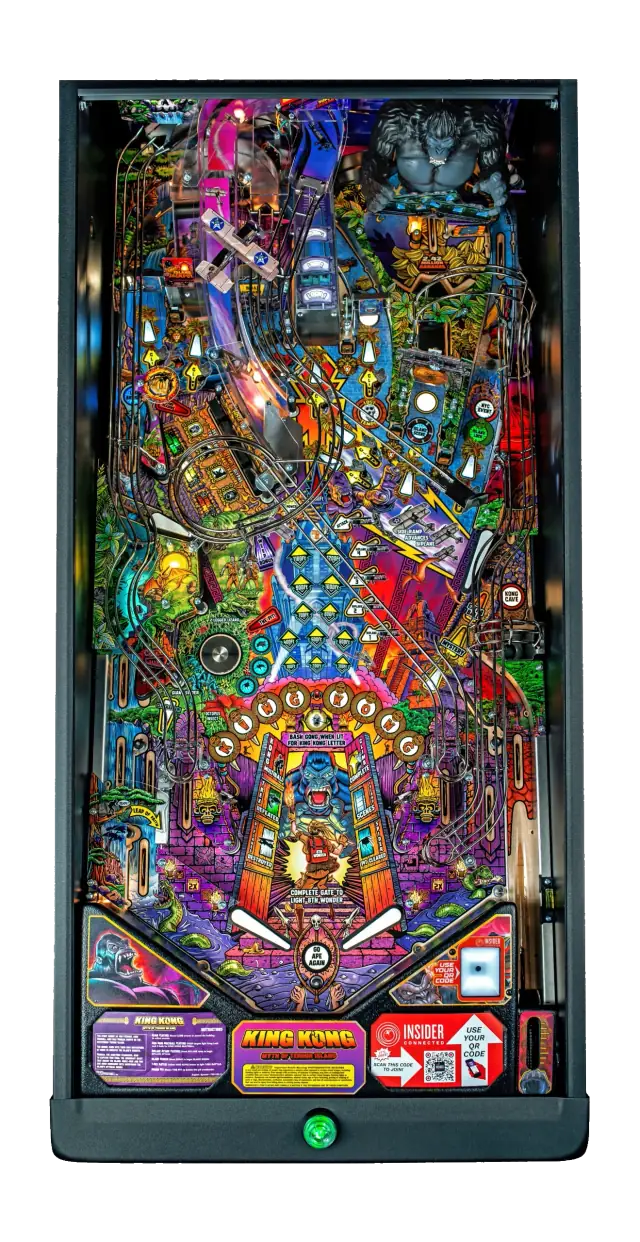
Silverball guide · King Kong: Myth of Terror Island
You choose how hard the mode is
King Kong makes you place a bet before its biggest modes: an easy multiball at ordinary scoring, a single ball on a clock at triple, or the strangest option in modern pinball, a fixed number of flips.
The NYC Event modifier is your bet
Complete the climb shots on the current level of the building and the right orbit lights for an NYC Event. Before it starts, the left flipper chooses how you want to play it, and the choice sets the scoring multiplier.
Three-ball multiball scores at 1x. Advancing a stage will usually add a ball if you are below three, and draining to one ends the mode. Single-ball on a sixty-second timer scores at 3x, opens with a twelve-second ball save, and pays a bonus for the time you have left.
In between sits the limited flip count at 2x, which is unlike anything else on a modern machine. Each flipper starts with thirty flips of its own. The gong adds ten to both, up to three times; advancing a stage adds three to each; draining subtracts five from both. When one flipper runs out it simply stops working and you play on with the other. When both run out, the ball is taken from you.
The rule that turns this from a preference into a plan: each modifier can only be chosen once. You will play all three eventually, so the question is which mode you spend each on.
Playing five island scenes is not the same as completing five
Six objectives sit above the flippers and all six are needed for the wizard mode, 8th Wonder. The island scenes are the first of them, and they are scored in two stages.
Playing all five scenes credits the objective at level one. Completing all five credits it at level two. You can repeat a scene as many times as you like until you finish it, so a failed scene is a delay rather than a loss.
Each scene runs sixty seconds and completing one awards a map segment. The gong extends the timer by fifteen seconds, once per scene, which is a large fraction of the clock and is easy to forget in the middle of a mode.
Finishing all five also opens the Crash the Gate mini-wizard mode.
Climbing the building is the spine of the game
Yellow climb arrows take you up the building shown above the flippers. Four inserts light at random, each worth twenty-five feet, and completing the set lights another. From the fourth set the arrows go to five at twenty feet each, and from the seventh set to six. The lit powerup target briefly lights every climb arrow at once.
The awards are what make this the spine rather than a side ladder. Two hundred feet lights an island lock and an extra ball. Three hundred feet lights the first NYC Event, six hundred the second, a thousand the third. Four hundred spots a KING KONG letter and seven hundred a map segment. Five hundred and nine hundred feet light further island locks.
So climbing feeds the events, the locks, the letters and the map at once, and there is rarely a reason not to be taking climb shots when nothing better is lit.
Island locks turn a scene into a two-ball, at a cost
Island lock lights at the right orbit at two hundred and five hundred feet, and when lit the right orbit diverts into a hidden sinkhole. Using it upgrades an island scene into a two-ball multiball.
The cost is real: while a scene is running as a two-ball, you cannot advance towards any other multiball until you are back to a single ball. Any multiball can be started during an ordinary scene; not during a locked one.
What you buy is two features. Island Jackpot: after any progress shot, the cliffs ramp lights the jackpot at the pit, worth five million plus everything the mode has scored so far, and knocking the held ball into the pit targets with the other ball within five seconds doubles it. And Victory Challenge: complete the scene while still in multiball and every shot is lit for a share of the mode total, five per cent for easy shots and ten for hard ones, with the gong then paying half the mode total as a victory jackpot.
That is a lot of value for one lock, and it is the reason the climb shots that light the locks matter more than their points.
The five island scenes
Save Ann builds a value at the gong from lit shots, with combos doubling both the score and the increase. Three gong shots then light a final hurry-up worth the total of the three you collected.
Cross the Chasm is the one with a punishment attached. The river entrance raises the log diverter and lights the cliffs ramp for a few seconds; miss it and a sailor falls, resetting the base value to one and a half million. Comboing the U-turn straight after a rescue multiplies the base value.
Pterodactyl Attack wants the moving drop target, then the Kong Cave for double, or triple if you trigger the rollover above it on a clean shot. Making the cave without the upper flipper adds three million.
Stegosaurus Encounter offers a slow-flashing easy path and a fast-flashing hard one on every shot. Both progress the mode and both pay the same base, but every hard-path shot adds a multiplier for the rest of the mode. Escape the Swamp is the fifth, worked at the punchback target.
Biplane Attack, and two combos worth learning
Three shots to the side ramp start Biplane Attack, a thirty-second mode where the side ramp is lit for a jackpot that grows as you hit other switches, with the two spinners alternating to set how much each switch adds. You can shoot down several biplanes in one round.
Two named combos feed it and can be made at any time during single-ball play, which is what makes them worth learning as habits rather than as mode shots. The barrel roll is left orbit into side ramp and adds 250,000 to the next biplane destroyed. The chandelle is river, punchback target, side ramp, and adds 500,000 plus fifteen seconds to the mode's timer.
Because both can be banked before the mode starts, an attack entered with a couple of these already in hand is a different proposition from one started cold.
Where the cabinets differ
The gong is the big one. Pro machines do not have it, so island scenes are lit by collecting blue island arrows instead: one for the first scene, rising by one per scene to a maximum of five. Everything in this guide that says to hit the gong for a timer extension applies to a Premium or LE.
In Save Ann, a Premium or LE lets each gong shot send the ball into the VUK, which a Pro has no equivalent for.
There are further Premium and LE features our source names in passing, including releasing all three balls from the train for Kong awards at the side ramp. UK floors carry both Pro and Premium machines.
A note on this source
This is a very new machine and the sheet shows it. Several values are left as question marks in the original, particularly in the NYC Event phases, and we have left those gaps as gaps rather than guessing at them.
Our copy is unattributed. Treat the structure as reliable and the individual numbers as a snapshot of the code as it stood when someone sat down to write it.
Where this came from
Silverball wrote this, but not from scratch: it was compiled against the published rules below and checked against them, rather than written up from one person’s games. None of the wording is theirs. Machines get code updates that move the right shot, so a guide has a date on it for a reason.
- King Kong: Myth of Terror Island community rule sheet (author not recorded in our copy)