Silverball guide · Star Trek
Your medals are not paid until you cash them
Every mode you play banks a medal, and none of them score until you start a wizard mode — where a complete set is worth far more than the same medals counted one by one. Here is how to protect the set, and the one shot that quietly locks you out of gold.
Six missions, four levels deep
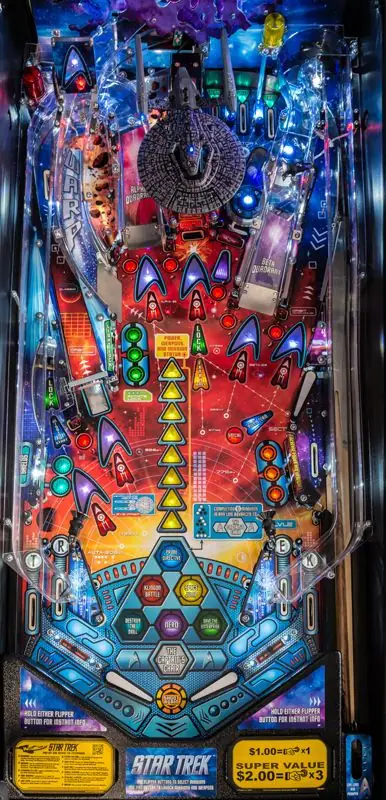
The hexagons in front of the flippers are six missions: Prime Directive, Space Jump, Save the Enterprise, Nero, Destroy the Drill and Klingon Battle. Start one at the left scoop or at the Away Team rollover under the upper flipper, and shoot the arrows lit in that mission's colour.
Each mission exists at three levels, and you can only reach a level by finishing the one below it. Level I runs on a thirty-second timer and ends by lighting every shot for a single final shot, which counts even if you drain during it. Levels II and III introduce a multi-coloured arrow among the ordinary ones, and that arrow is the one that matters.
A combo doubles what a shot would have paid, which is worth knowing before any of the rest of this.
Medals are banked, not scored
How well you play a mission is recorded as a medal: bronze at three shots, silver at six, gold at nine. Medals accrue rather than replace one another, so reaching silver leaves you holding the bronze as well.
None of that scores at the time. The medals are paid out in a lump when you start a wizard mode, and the rate depends on which wizard mode you reach. At Kobayashi Maru a single bronze is worth a million and a full set of six is worth ten. At Enterprise Amok the set is fifteen million, and at Five Year Mission it is twenty-five, rising to seventy-five for a full set of golds.
Read those two numbers against each other. Six single bronzes counted individually come to six million; the same six as a complete set pay ten. The game is not asking you to score well in one mission, it is asking you to leave no mission unplayed.
The Away Team shot, and when not to take it
Once you have made a mission shot, the Away Team rollover under the upper flipper upgrades the mission in progress. It adds twenty seconds to the timer and replaces the objective with a smaller set of specific, far more valuable shots. It is available during Level I only, and most of the time it is the right move.
Space Jump is the exception, and it is worth committing to memory. Taking the upgrade there leaves the Vengeance as the only shot available, and hitting it advances you one medal rank and ends the mission on the spot. Do that before you have six shots in and you have taken silver instead of gold, with no way back into that mission at that level.
So on Space Jump the upgrade is an ending, not an extension. Everywhere else it is the cheapest points on the machine.
Finish a mission on a combo
A medal is worth double if you combo into the shot that earns it. Not the shot after, not the mission as a whole; the specific shot that takes you to three, six or nine.
That doubling stacks with double scoring from the warp ramp, which is where the sheet's own example of a single gold medal worth several million comes from. It costs nothing but shot selection, and it is the difference between a set of medals that pays well and one that pays twice as well.
It follows that the last shot of a mission is the one to slow down for, even on a machine that spends the rest of its time asking you to hurry.
What carries, and what does not
Every mission shot is worth a hundred thousand times the mission's level, plus a shot bonus, plus a streak bonus, plus thirty thousand for each shot already made in that mission. Both bonuses start at nothing and grow as you shoot: five thousand a shot on the first, ten thousand a shot on the second.
The difference between them is the part to remember. The shot bonus carries for the whole game. The streak bonus resets when you drain.
A long ball is therefore worth more than the sum of its shots, and the value you build early is not entirely lost when you lose the ball. What you lose is the streak, which is the faster-growing half.
Level III buys a permanent multiplier
Completing a mission at Level III lights a two-times multiplier on one specific shot for the rest of the game, replacing that shot's combo arrow. Each mission pays out on a different shot: Prime Directive on the left scoop, Space Jump on the right orbit, Save the Enterprise on the right ramp, Nero on the left orbit, Destroy the Drill on the warp ramp and Klingon Battle on the left ramp.
Which mission you push deepest is therefore a decision about which shot you want doubled for the remainder of the game, and the right answer depends on what you actually hit reliably.
Completing three missions of the same level in a line also enables the Captain's Chair, which awards super pops, super ramps or the super spinner depending on which line you completed. It stays live until you finish it, across balls, and finishing two lines at once pays both.
The warp ramp is the extra ball
Repeated warp ramp shots climb a scale. Seven of them reach Warp 4 and award the extra ball. Ten reach Warp 9.1 and give sixty seconds of double scoring. Eighteen reach Warp 9.9, which is double scoring again and a second ball dropped into single-ball play.
The extra ball is available once, but the double scoring and the extra ball into play can be earned again, which makes the warp ramp the shot to keep returning to rather than one to tick off.
Sixty seconds of double scoring is also the window in which a combo-doubled gold medal is worth four times its base value, so it is worth having a mission ready rather than starting one from cold.
Stack the multiball onto a mission
Klingon Multiball starts by completing the green standups to light locks at the Vengeance and the left scoop, then locking three balls. Its jackpots begin at two hundred thousand and climb; the seventh is a super jackpot, the fourteenth another, then a travelling double jackpot, and finally the warp ramp lights for a double super jackpot worth twenty million that also hands you a gold medal outright.
Start it on its own and it is a multiball. Start it just after a mission and the mission runs underneath it. If the third lock is lit at the left scoop while mission start is also lit there, you can choose a mission and go straight into the multiball from the same shot.
The black hole to the right of the Vengeance gives an add-a-ball once per multiball when lit, and the red matter standups are what light it.
The Vengeance, and where the sheet stops
The Vengeance has its own sequence of three. The first is a multiball where hitting the magnet-held ball at the start adds a ball and extends the ball save. The second is a hurry-up over five shots that pays an extra ball for destroying the ship. The third raises a drop target, and knocking it down opens a very short window on the Vengeance worth a tenth of your total score or ten million, whichever is larger, doubled by a combo and multiplied again by double scoring.
Torpedoes, collected three at a time from the torpedo standups and fired with the button, count as Vengeance hits. They do not count as mission shots, and they cannot make the final shot of Vengeance Multiball. They are for the ship, not for the mission you happen to be in.
The three wizard modes are Kobayashi Maru after all six missions at Level I, Enterprise Amok after Level II, and Five Year Mission after Level III. Our source describes the first two in full and breaks off mid-sentence on the third, so this guide stops where it does: Five Year Mission begins as a four-ball multiball with every shot lit, and we would be inventing the rest.
Where this came from
Silverball wrote this, but not from scratch: it was compiled against the published rules below and checked against them, rather than written up from one person’s games. None of the wording is theirs. Machines get code updates that move the right shot, so a guide has a date on it for a reason.
- Star Trek (Stern) rulesheet (author not recorded in our copy)