Silverball guide · Teenage Mutant Ninja Turtles
Your turtle is a strategy
The choice you make in the first three seconds shapes the whole game, and the training levels stacked on top of it are the part almost nobody works through.
Choosing is not a cosmetic decision
You pick a turtle at the start and it is easy to treat that as picking a colour. It is not. Each turtle carries a different set of perks, and those perks unlock as you train.
Leonardo starts with training lit, then adds ten seconds to timers, then doubles Weapon, then doubles Team-Up. Donatello starts with Turtle Power lit, then doubles Foot, then extends ball save, then triples Turtle Power. Raphael starts with episodes lit, then doubles Krang, then adds a playfield multiplier, then triples episodes. Michelangelo starts with Battle Again lit, then doubles April, then doubles the pizza eating contest, then triples Ninja Pizza.
Read those as strategies rather than trivia. Donatello is a multiball game. Raphael is an episode game and the only one that hands you extra playfield multiplier. Leonardo buys time, which is the scarcest resource in any mode. Michelangelo is built around pizza.
Training is the engine
Every turtle starts each game at level one, and every level — including the first — carries its perk. Getting to level four is what makes a turtle feel genuinely different from the other three.
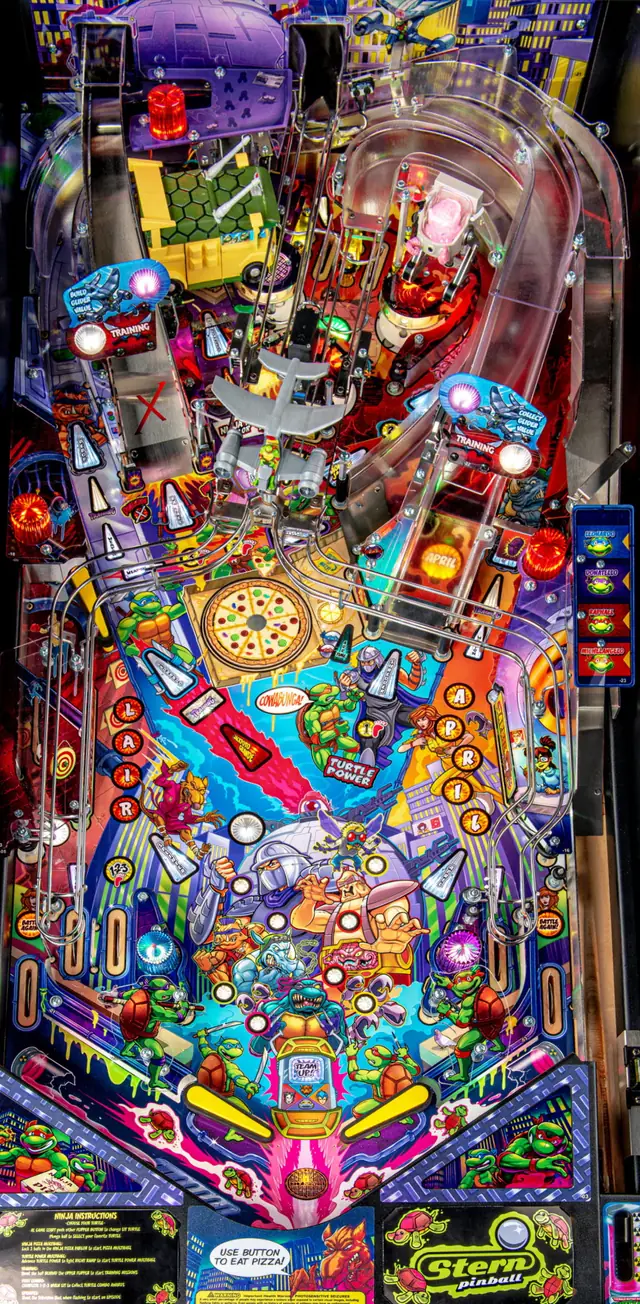
You light training at the LAIR target, which needs four hits to spell it. The catch is that each letter starts timing out on its own, so a slow LAIR resets to nothing and you begin again. It wants a burst of attention, not a casual poke between other shots.
Completing LAIR gives you one of two awards: it lights training if training is not already lit, or it lights playfield 2X. After two completions LAIR needs re-enabling, and starting an episode is what re-enables it.
So there is a natural rhythm to this machine — start an episode, work LAIR, take training or the multiplier, repeat — and players who never find it are playing a much shallower game.
Eight episodes, and two wizard modes
Shoot the left and right ramps to light Start Episode. There are eight in total, two of which have to be unlocked and which score a little more for being harder. Every episode has two endings, a success and a failure, and which you get matters more than it looks.
Four completed episodes start Team-Up Multiball. All eight start Final Battle Multiball.
Between episodes, the playfield 2X target randomly changes which episode is queued up, so you have some influence over what you are about to play.
Which episodes you finish decides how Team-Up plays
This is the cleverest thing in the ruleset and the reason to care about completing episodes rather than merely starting them.
In Team-Up Multiball you and a partner try to rescue the other three turtles, and every episode you previously completed carries a specific advantage into that mode. One doubles the pizza party. One has Bebop and Rocksteady take each other out. One rescues any turtle outright. One makes the return lanes spot a bad guy. Others double the rescue value, double Shredder, add points per bad guy, or make a single foot kill everything on screen.
Your partner depends on your turtle too: Splinter for Leonardo, Metalhead for Donatello, Casey Jones for Raphael and the Neutrinos for Michelangelo.
The practical consequence: a failed episode still counts towards starting Team-Up, but it does not bring its gift with it. Finishing four episodes properly gives you a meaningfully easier wizard mode than scraping four starts.
Pizza toppings rewrite the multiball
Lock three balls in the Pizza Parlor for Ninja Pizza Multiball, and then look at your toppings, because they are not decoration — they change the rules of the multiball you are about to play.
Ice cream starts the jackpot already lit. Chili pepper starts the super jackpot lit. Marshmallows make the jackpot series unlimited. Gummy bears add a ball. Octopus starts a pizza frenzy. Pepperoni, anchovies and sausage raise various values, pineapple and fudge add foot spots and kills, and peanut butter adds a slice.
Three of those — chili pepper, marshmallows and gummy bears — are worth substantially more than the rest. If you have any influence over your toppings before locking the third ball, that is where the value is.
The small stuff that adds up
At the start of each ball a shot blinks in your turtle's name and colour for a few seconds; hit it before it times out and you light Weapon.
Weapon then pays off through the return lanes. Roll down the lit Weapon lane and a hurry-up starts on the opposite orbit; collect that and a second hurry-up starts on the centre ramp. Two hurry-ups from one rollover is good value for a shot you were making anyway.
The Foot 1-2-3 combo lane is lit at the start of every ball as well, and rolling it starts a mini-mode wanting three shots in a row.
Turtle Power Multiball is the straightforward one: shoot the right ramp when lit, four times. If you are playing Donatello, that is the multiball your perks are built around.
What changes between cabinets
There is more edition difference here than on most modern Sterns, and some of it is strategic rather than cosmetic.
The Premium and LE have a glider toy with a controllable diverter. When the action button is purple you can point the glider left or right at any time, which decides whether the centre and left ramps feed your left or right flipper — genuine ball control that a Pro simply does not have.
Those cabinets also get the Glider feature: point it left to light Build Glider on the left ramp, shoot the left ramp as often as you like to build the value, then move the glider and shoot the right ramp to collect before it times out. Moving it resets the timer, so you have some control over the collect.
The mushrooms topping, which makes the Lair a time lock, is Premium and LE only. Going the other way, the top lane skill shot — plunging to the top left lane for extra points and bonus multipliers — is Pro only.
Where this came from
Silverball wrote this, but not from scratch: it was compiled against the published rules below and checked against them, rather than written up from one person’s games. None of the wording is theirs. Machines get code updates that move the right shot, so a guide has a date on it for a reason.
- Stern Pinball, Teenage Mutant Ninja Turtles (Pro) rules sheet