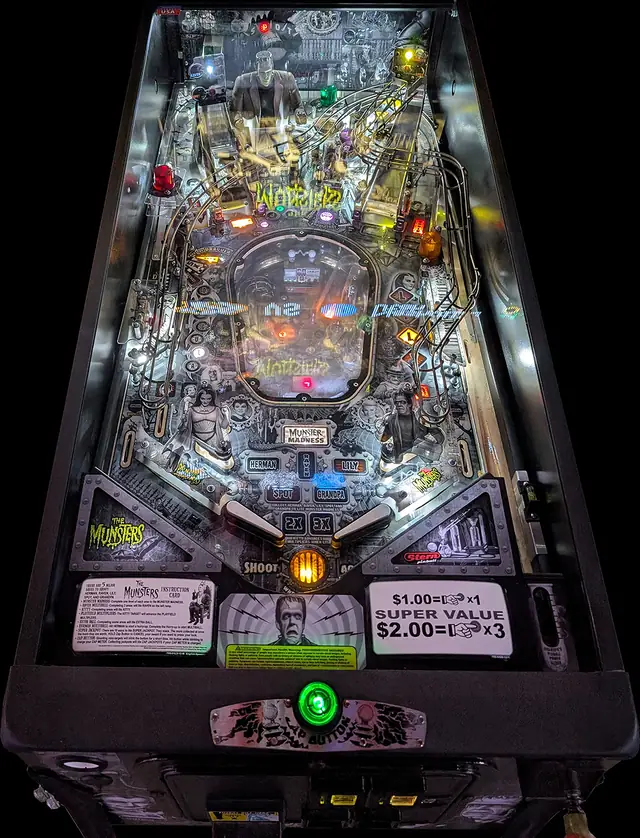
Silverball guide · The Munsters
Stack the super jackpots, then collect them all at once
There are ten ways to qualify the Dragula lane for a super jackpot, and every one of them stacks. You can also refuse to collect and keep stacking. Doing that with the playfield multiplier running is the whole game.
The one rule that matters
Ten different features qualify a super jackpot at the Dragula lane, eleven on the Premium and LE, and they all stack on top of each other rather than replacing one another. Shooting the lane collects everything you have stacked.
The refinement is the zap button: hold it as you collect and the collection is cancelled, leaving the stack intact so you can keep building. That single button is the difference between a modest game and a large one.
Kitty is the multiplier
Completing any family member level enables the Kitty target to advance the playfield multiplier, which climbs from two to three to six and runs for about a minute.
Hitting Kitty again while it is running resets the timer rather than wasting the shot, and pays points and bonus multipliers as well. Six times playfield scoring with a tower of super jackpots waiting at the Dragula lane is what a good ball on this machine looks like.
The five family members are five different jobs
Herman is a hurry-up followed by shooting the magnetised ball, which starts his multiball. Spot is drawn out from under the stairs by shooting the ramps and then played with at his target under the left ramp. Grandpa comes from completing the purple targets to collect chattering teeth, which lights him at the scoop. Lily wants her target four times for a frenzy. Raven needs three left ramps, after any family member has been played.
Completing them all at one level lights Munster Madness. This is a machine designed to be readable by a novice, and the family members are where that shows: each is one clear thing to do.
Herman is three modes in a row
Shoot Herman enough times to start his hurry-up, then shoot him again for up to half a million, which also captures the ball on the magnet in front of him. A second ball is then auto-plunged to your flippers, and shooting the captured ball collects twice the hurry-up value.
Herman Multiball starts either way. But collecting that Monster in the Park hurry-up gives you three balls instead of two, which is a large difference for one shot. At level two the hurry-up starts at ten times its base value, and the jackpots stop requalifying on their own.
Spot has a feed worth respecting
Shoot the left or right ramp when it is lit red to collect a SPOT letter and briefly raise Spot from under the left ramp. Hit him during that window and you get a bonus letter, which is the fast way to complete SPOT and start his mode.
In the mode itself, Spot wants four shots for rising awards, and completing all four qualifies his super jackpot. The sheet is blunt about the risk and so is the machine: it is an awkward feed, and the shot that pays you is also the one most likely to end your ball.
Dragula does more than collect
Landing in the Dragula lane raises your bonus multiplier, pays out based on your progress on the DRAGULA target, and boosts a random character so their modes score more for a while.
Spelling DRAGULA qualifies five times at the lane, and so does shooting the lane again shortly after a previous visit. During a multiball, spelling DRAGULA lights the lane to add a ball, with a short ball save attached, and Raven Multiball gives that instantly.
The mystery is on a counter
The scoop is lit at the start of the game for a mystery award, which also lights the mystery super jackpot, and it relights after ninety chattering teeth.
Ninety is a large number that arrives on its own if you are working the purple targets for Grandpa, which is a good reason to keep taking them even when he is not what you are chasing.
Munster Madness
The wizard mode is a four ball multiball started at the scoop once every family member has one level completed, and once whatever you were already in has finished.
Its first stage asks for three areas, three times each, inside fifteen seconds, in a fixed order: Herman, Raven, Lily, with Spot and Grandpa added on later cycles. Then the scoop pays a hurry-up sized by what you scored in that stage, and you go round again with more shots required.
Everything has two levels
Family members, and Munster Madness itself, each have a second level. The second level of the wizard mode opens by telling you what buff each family member will hand you if you shoot their area, and completing any one of them moves you on.
So the machine is shallower than its contemporaries on the first pass and deeper on the second, which is a deliberate design rather than an oversight.
The menu is worth a look
Holding both flippers in attract mode offers more than the usual. Competition removes the random elements, Dragula and Kitty included, which changes the machine substantially.
There is also Impossible, where extra balls are off, the rules are set to very hard and you cannot hold a flipper for more than two seconds, and Couch Potato Challenge, a two ball frenzy that ends after twenty shots and keeps its own high scores. If you find a Munsters on a quiet night, that last one is the one to show somebody who does not play pinball.
The lower playfield, if you find a Premium
Grandpa's Laboratory is Premium and LE only, and it is a genuine second playfield with its own set of flipper buttons. A countdown on the display tells you it is coming.
You have a set time to activate the Machine by shooting both outer orbits and then the Machine itself, with the ramp adding time and the saucer paying a mystery award and spotting an orbit. Activate it and Grandpa Multiball begins down there, which also counts as completing a family member level.
Where this came from
Silverball wrote this, but not from scratch: it was compiled against the published rules below and checked against them, rather than written up from one person’s games. None of the wording is theirs. Machines get code updates that move the right shot, so a guide has a date on it for a reason.
- The Munsters rule sheet (author not recorded in our copy)