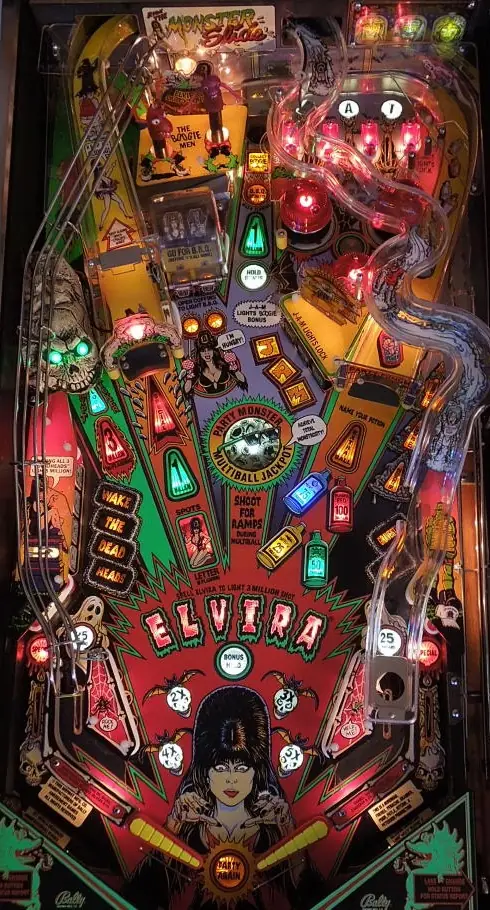
Silverball guide · Elvira and the Party Monsters
The machine remembers the last player
Elvira's multiball jackpot builds towards four million and stays there, game after game, until somebody collects it. The letters you need to reach the three million shot carry over too, so a fresh game can start most of the way to both.
What carries over, and why it matters on a public machine
The Party Monster multiball jackpot can be set progressive rather than fixed. When it is, it starts at a million, grows with essentially every point you score during multiball, caps at four million, and is held from game to game until somebody collects it. Nobody resets it by walking away.
E-L-V-I-R-A letters behave the same way. They can be set to carry ball to ball, game to game, or not at all, and the default is game to game. Spelling ELVIRA lights the Skull Lock for three million on a twenty-second timer, and if you miss it the game only drops you back to E-L-V-I rather than clearing it.
So the first thing worth doing on a machine somebody has just left is looking at what is already lit. A game can begin with most of ELVIRA spelled and a nearly maxed jackpot sitting in the multiball, which changes what you should shoot for on ball one.
The extra ball ladder is designed to get harder
The Party Punch ramp pays a rising value and lights an extra ball at the top of the ladder. The first time, it starts at 175,000 and takes four shots. Collect the extra ball and it does not start again from there: the base resets to 100,000, which is seven shots. Collect a second and it resets to 10,000, which is eleven.
There is no limit beyond what the operator sets, but the machine is openly pricing you out, and the source says as much. The value carries from ball to ball until the extra ball is collected, and only then does it reset at the start of every ball.
You can read where you are without the display: the ramp value is the sum of the lit potion bottles in front of the ramp entrance, except when it has been knocked back to 10,000.
Wake the Dead Heads is the best repeatable shot in the game
Four standups on the left wall. Completing them pays 20,000, then 40,000, 50,000, 60,000, 70,000, 80,000, and then 200,000 every time after the sixth, which is a large number on a 1989 machine.
The third completion is the one to aim for, because it lights the centre eject hole for one million, untimed, for the rest of the ball. The sixth completion on a single ball lights the special. And the escalating values carry from ball to ball until Million is lit, at which point they reset each ball, so there is a real cost to lighting it early if you were building the ladder.
The two ramps do opposite things
The Monster Slide, on the left, pays 50,000 rising in 25,000 steps to 300,000, and two consecutive shots light Hold Bonus at the centre eject. Four consecutive shots light it for a million, and each time you do that the requirement grows by one, up to eleven shots.
It is also where E-L-V-I-R-A letters are collected, lit by completing B-A-T, J-A-M or Wake the Dead Heads, or by taking the million.
During multiball their behaviour splits. The Monster Slide loses all its usual awards except the special, while the Party Punch keeps every one of its standard values. Both ramps must be shot to collect the multiball jackpot, and afterwards each ramp pays 250,000 as a party ramp. Two balls up the Monster Slide in quick succession pays a 500,000 double slide.
The centre eject is where four things are cashed
It can be lit for the barbecue bonus, the boogie bonus, a million, or hold bonus, and it kicks the ball out to the B-A-T lanes.
The barbecue bonus comes from opening both coffins with the two flip-up targets, and it is a random award: extra ball, bonus multiplier, an ELVIRA letter, a mystery score or a special. It does not stack, so collect it before opening the coffins again. The boogie bonus comes from the J-A-M drop targets, starts at 25,000, and grows 1,000 per bumper hit while it is lit, with another 10,000 for completing J-A-M again; it caps at 255,000.
B-A-T advances the bonus multiplier to 5x and lights the Skull Lock. Once the multiplier is maxed, completing B-A-T pays 70,000 rising to 150,000 instead.
Multiball, and where to park a ball
Three balls in the Skull Lock start it, and all three are ejected into the thumper bumpers. The bumpers are the place to park a ball, because you can put one there from the Skull Lock, the centre eject or the Pizza Passage, which gives you three different ways to buy yourself a clean shot.
Locking is not difficult here and the source says so plainly. The Skull kicker is the known weak point: it often kicks softly enough to drop the ball into the centre lane instead of carrying it to the bumpers, and from there it frequently drains straight down the middle.
A note on this source
This was compiled from Bill Ung's rule sheet, written in 1996 and 1997, which carries a note that it is freely distributable if unmodified. Our credit names him because the document does. None of his wording is reproduced here; the guide is our own prose about how the machine behaves.
It is a document about a 1989 Bally machine written by an owner, and it is candid about hardware as well as rules, including the weak Skull kicker above. Many values are operator-adjustable, among them the consecutive ramp shots needed for Hold Bonus and Million, how far ELVIRA resets after a missed three million, and whether letters carry between games at all.
Where this came from
Silverball wrote this, but not from scratch: it was compiled against the published rules below and checked against them, rather than written up from one person’s games. None of the wording is theirs. Machines get code updates that move the right shot, so a guide has a date on it for a reason.
- Elvira and the Party Monsters rule sheet, by Bill Ung, 1996-1997