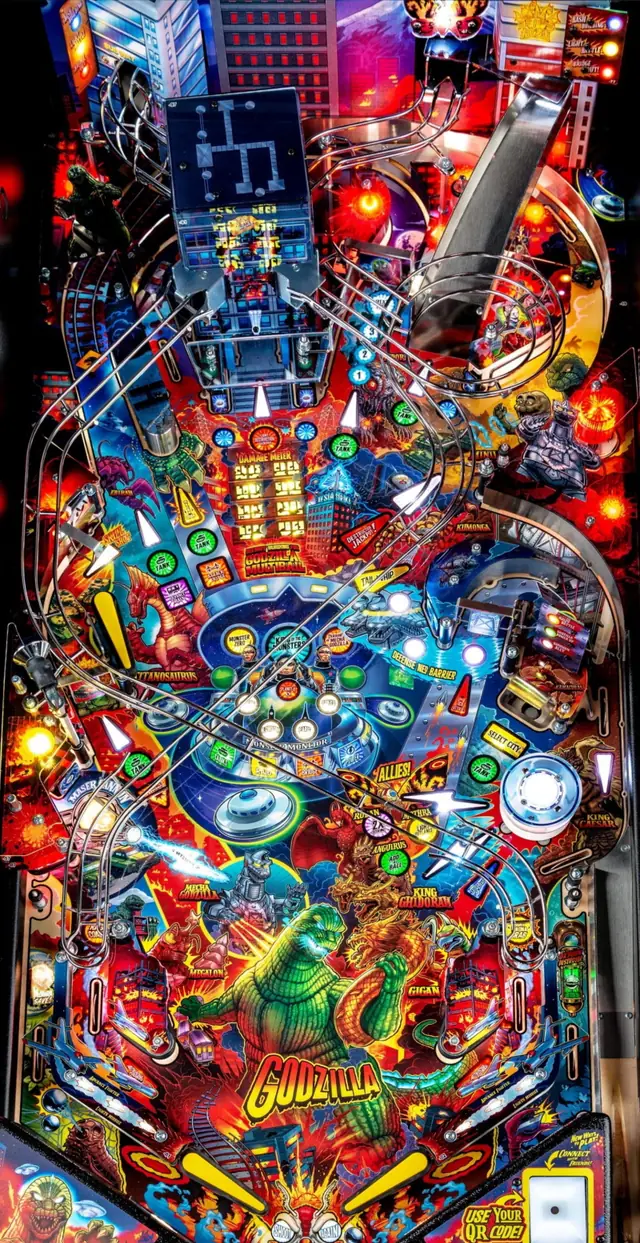
Silverball guide · Godzilla
Where the points actually are
Godzilla looks like a game about monsters and plays like a game about cities. The scoring lives in a bonus most players never collect on purpose.
The game underneath the game
Almost everything Godzilla puts in front of you is a mode: a kaiju to fight, tanks to shoot, a bridge to knock down. Play it that way and you will have a good time and a mediocre score, because the modes are not where the points are. They are the ingredients.
The engine is the city. You arrive somewhere — Tokyo first, always — and the game quietly starts totting up how much of it you have wrecked. When you leave for the next city, it pays out. That payout is the Carnage Bonus, and on a good game it is worth more than every jackpot you collected getting there.
So the question to ask on every ball is not “what mode can I start”. It is “what am I taking with me when I leave this city”.
Four boxes to tick, and only one is compulsory
Each city tracks four things on the Monster Monitor: Raid, Tanks, Bridge and Power. Raid means beating the city's Tier 1 kaiju. Tanks, Bridge and Power mean playing out Tank Attack Multiball, Bridge Attack Multiball and Tesla Strike respectively — starting them is not enough, you have to see them through.
Only Raid is required to move on. The other three are entirely optional, and skipping them is the single most common way a decent player leaves half their score on the machine. Each one you finish lights an Annihilation Bonus, and the Annihilation Bonuses are what the Carnage Bonus is made of.
The one-ball rule
This is the piece of Godzilla worth actually memorising, because it is invisible and it is expensive.
An Annihilation Bonus multiplies the payout only while it is running on the ball you are currently playing. Drain, and the ones you had going stop contributing — and their value drops back to a floor of 20 million rather than the number you had spent three modes building.
The consequence is a plan, not a tip. Getting Tanks, Bridge and Power across three separate balls gives you three modest bonuses. Getting all three going on one ball, with real scores behind them, and then taking the city change, is the difference between a decent game and a memorable one. If you have two of them lit and the ball is still alive, the third is worth more than anything else on the playfield.
Win the fight before you travel
Beating a city's Tier 1 kaiju does more than tick Raid. It leaves Godzilla in control of that city for the rest of the game, which is a permanent bonus multiplier and a permanent perk — London raises the Destruction Jackpot, New York raises saucer value, Paris raises loops, Tokyo raises the Annihilation Bonus.
Leaving a city before you have won there hands it to the monster for good. There is no going back to a city you have left, so a hurried city change is a decision you live with for the whole game.
The counting perks are worth knowing too: the second city you take gives an extra ball, and the fourth gives forty million and a large permanent boost to the Destruction Jackpot. A player who wins in Tokyo and then wins again has already banked more than most games manage in total.
Pro and Premium are not the same machine here
Both editions run the same rules, but three of the routes differ, and advice written for one is wrong at the other.
Godzilla Multiball: on a Pro, once the building is wrecked you simply shoot the building to start it. On a Premium or LE you have to physically lock three balls, and the third lock starts the multiball.
Mechagodzilla's shield: the Premium and LE give you a bank of three standup targets to knock down. The Pro uses the right spinner as the right-hand shot instead, so on a Pro a good spinner rip does the work the target bank does elsewhere. The same substitution applies during Mechagodzilla Multiball.
The bridge: when it collapses, the Bridge Out ramp you need is chosen by the building's position on a Premium or LE, and at random on a Pro. On a Pro, look before you shoot.
Two things for the plunge
Godzilla's skill shots are generous and stack up: each unique one you make raises the value of the ones after it, and most of them buy you ball save time, which on this machine is worth having.
The one to learn is the two-part one. Full plunge into the left spinner lane behind the upper flipper for the lit skill shot, then go straight to the scoop without touching another switch. It pays ten million, two Godzilla power-ups, and lights and collects an ally — and it makes every secret skill shot for the rest of the game worth more.
Where this came from
Silverball wrote this, but not from scratch: it was compiled against the published rules below and checked against them, rather than written up from one person’s games. None of the wording is theirs. Machines get code updates that move the right shot, so a guide has a date on it for a reason.
- Stern Pinball, Godzilla (Pro) rule guide