Silverball guide · Judge Dredd
One target changes every mode
Judge Dredd hides a single standup target that is lit during every mode and does something different in each. In half of them it is worth more than any shot the mode is actually asking you to make.
The bonus target, once per mode
During every chain link the bonus target is lit, and hitting it puts it out for that mode. What it does depends entirely on which mode you are in, which is why it is easy to play this machine for years without noticing it matters.
In Battle Tank and Manhunt Millions it adds ten seconds to the timer. On a mode that runs twenty or thirty seconds, that is an enormous proportion of the round.
In Bad Impersonator it lights three drop targets at a time instead of two. In Melt Down it secures all three reactors and pays the points for them. In Stake Out it doubles the right ramp from five million to ten. In Pursuit it fires two missiles instead of one, and in Black Out it simply hands over ten million.
The practical rule is to take it early rather than as an afterthought, particularly in the timed modes where the extra seconds compound with everything else you were going to shoot anyway.
Advance the crime level before you collect
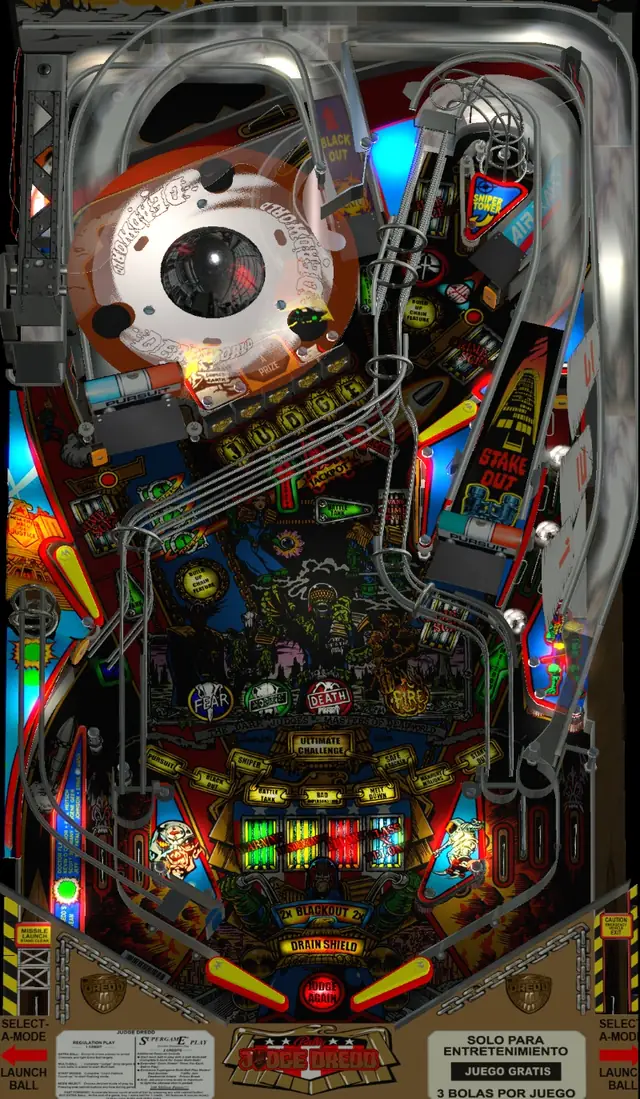
Five Crime Scenes sit around the playfield: the left orbit, the small loop, the Sniper Tower, the large loop and the right ramp. Usually four are lit at the start of a game, at random levels, and they stay lit until you shoot them.
The levels are worth a million a scene at Warning, two at Misdemeanor, three at Felony and four at Class X Felony, shown by colour: green, yellow, red, white. The Advance Crime Level target raises every lit scene one level and scores a million itself, and it goes out once everything lit is at Class X.
So the order is not optional if you care about the points. Advance first, collect second. Four lit scenes at Class X are worth four times what the same four scenes pay at Warning, for a handful of shots at one standup target.
Shoot them all and three or four more light at random levels. On the machine our source played, an extra ball came at seven crime scenes and another at twenty-two, then roughly every fifteen after that, which continues more or less indefinitely.
Nine chain links, and which ones repay the time
Links are started at the left ramp or the Sniper Tower when lit, alternating, with the left ramp first. When lock is lit only the Sniper Tower will start one. You get three million just for starting, and most run twenty to thirty seconds.
The repeatable ones are the best. Manhunt Millions lights the left ramp for six million a shot with nothing else to think about, and once you have the rhythm it runs up quickly. Stake Out is the right ramp for five million a shot, or ten with the bonus target.
The fixed-value ones are Battle Tank and Melt Down, both three million to start plus ten million a shot for three shots. Bad Impersonator pays five million a lit drop target and ten if you take both at once. Safe Cracker counts down from eight million and pays the same value on each of four Subway shots.
Pursuit is the one to be relaxed about. You are timing a ramp shot to hit a car swerving across the display, and thirty-five million only arrives if you actually hit it.
Black Out is a two-ball multiball with all playfield scoring doubled and the centre ramp lit for repeated ten million shots. The centre ramp is not easy, and a reasonable alternative is to spend the doubled scoring on JUDGE or on a ramp you can hit reliably.
Multiball, and the jackpot that does not carry
Knock down the JUDGE drop targets to light lock, then shoot the left ramp. On release code the first two locks simply travel round the ramp and the third goes to Deadworld and starts the multiball, with three more balls auto-plunged in.
The jackpot starts around twenty to twenty-five million and every drop target hit adds another million. Collecting a jackpot does not reset the value, so it keeps climbing. There are four in a fixed order, Mortis then Fire then Fear then Death, each five million above the last. The left ramp lights the jackpot and the Subway collects it.
Take the Death jackpot and Ultimate Challenge begins, with any balls you have lost relaunched. It all ends when fewer than two balls remain.
The sting is that jackpots are not held between multiballs, unlike Fish Tales or Indiana Jones. Miss Death and the next multiball starts again from Mortis, which makes finishing the ladder in one go considerably more valuable than it looks.
Super Games, one per ball
Four Super Games rotate, one per ball, and all are two-ball affairs with a Drain Shield for the first ten seconds. Drain one ball and you revert to normal play for the rest of that ball.
The trick is JUDGE. Complete the drop targets while you still have two balls in play and you get a six-ball frenzy instead.
The four differ: the first lights crime scenes for a super jackpot of around fifty-two million; the second builds a super jackpot at 7.5 million a ramp, collected at the Sniper Tower; the third pays five million per drop target down when you shoot the Subway, to a maximum of twenty-five; the fourth blows up Deadworld for forty-five million on a third virtual lock.
In every Super Game there is also a hundred million super jackpot, and it comes from hitting the Advance Crime Level target four times, not from the crime scenes themselves. That lights one top shot for ten seconds while the machine counts you down.
The skill shot and the combos
The ball is launched into the large loop, so take another large loop from the upper left flipper when it comes round. Five million and a good quote.
The combos are the left orbit into the small loop, and the left orbit into the small loop into the centre ramp for six million.
Worth knowing separately: an unlit ramp pays 500,000 multiplied by how many ramp shots you have made this ball. So ramps escalate on their own during a ball, and a ball spent shooting ramps is never wasted even when nothing is lit.
A note on this source
Our copy is a first-impressions write-up with the author's own later corrections inserted into the text, so in several places it states a value, then revises it. Where the two disagreed we have taken the correction.
It is unattributed, and it was written while the machine was new: it describes the Deadworld locking behaviour changing between prototype and release code, and it flags the left outlane as unusually cruel with the post in the middle position it shipped with.
Several numbers are explicitly guessed at in the source, and it says so. Treat them as approximate rather than exact.
Where this came from
Silverball wrote this, but not from scratch: it was compiled against the published rules below and checked against them, rather than written up from one person’s games. None of the wording is theirs. Machines get code updates that move the right shot, so a guide has a date on it for a reason.
- Judge Dredd rule sheet (author not recorded in our copy)