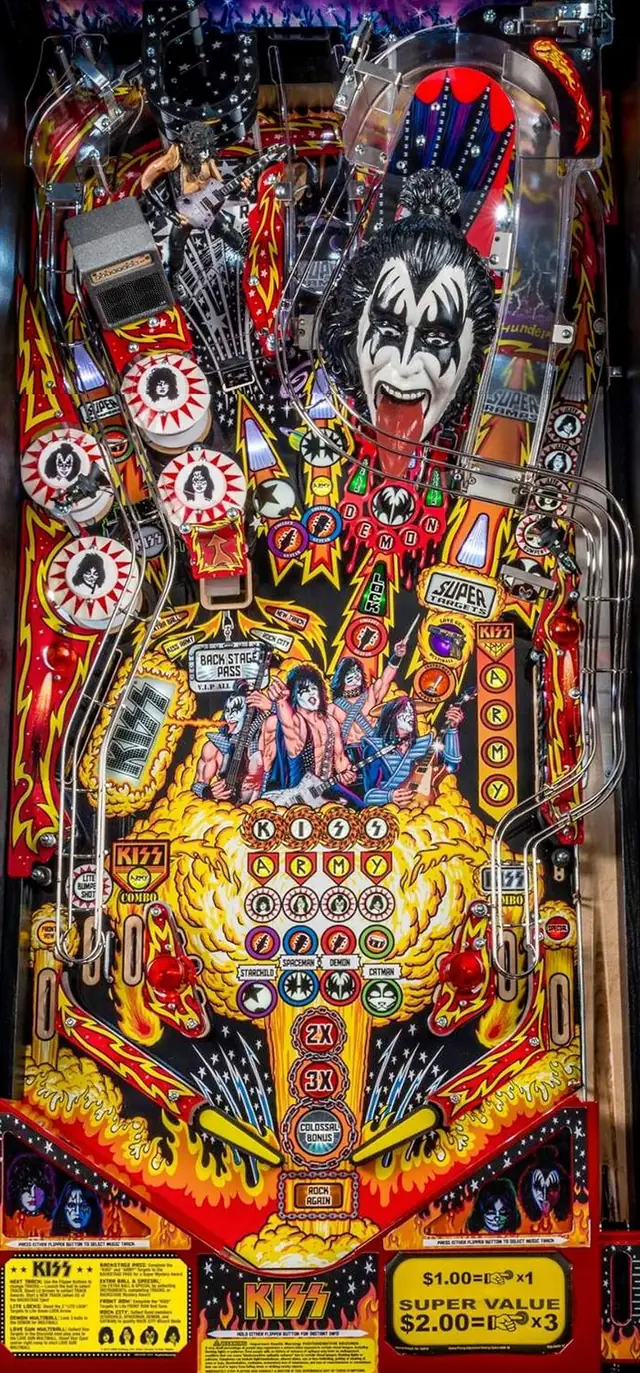
Silverball guide · Kiss
The grid is the score, and it carries between balls
Stern's KISS looks like a song machine and mostly is not. The thing quietly deciding your game is the grid, which fills up from four different sets of targets and, on normal settings, survives the end of a ball.
What the grid actually is
The grid is filled by collecting sets: KISS targets, ARMY targets, band members and instruments. Every set adds to your end of ball bonus, and completing the grid once lights the Heaven's on Fire wizard mode.
On normal settings it carries between balls, which is the whole reason to care. Progress you make on ball one is still there on ball three, so the grid rewards consistency rather than one heroic ball.
Songs are chosen, and then you are committed
You pick a song at the start of a ball and at the start of the game, and you cannot pick another until you have completed the one you are on. Mode progress carries from ball to ball.
That makes the choice heavier than it looks on a music machine. You are not sampling songs, you are committing to finishing one.
Multipliers on multipliers
There are four different multipliers running at once here and they combine rather than compete. Completing a song starts an untimed playfield multiplier that lasts the rest of the ball, stepping up through two, three, five and ten times as you finish more songs. Locking balls back in the Demon during his multiball adds two or three times on top, and those two add together, so five plus two is seven.
The shot multipliers work differently: taking both the KISS and ARMY hurry-ups makes your next shot double for the rest of the ball, and doing it again lets you set another shot to double, repeatable across the whole playfield. Shot and playfield multipliers multiply each other rather than adding.
The arithmetic tops out at fifty-two times on a single shot. You will not get there, but it explains why the machine feels like it pays nothing for an entire ball and then pays everything at once.
The combos are the scoring
There are fifteen named city combos, and each pays a million times the number of shots in it. They range from two shots, like centre ramp into right ramp, up to Detroit, which is that same pair alternated five times over.
Five city combos lights an extra ball on default settings. The realistic ones to learn are the centre and right ramp pairs, because almost every longer combo on the list starts with them.
Songs are untimed, which changes how you play them
Each song wants roughly eight to ten lit arrows, or in one case the flashing KISS targets, and there is no clock on any of it. Deuce moves a pair of lit shots across the playfield each time you hit one. Lick It Up starts with two neighbouring shots and moves the pair somewhere else with each hit. Hotter Than Hell alternates between the KISS targets and a random major shot.
Untimed means there is no reason to rush and every reason to set up. Cradle, look at what is lit, and take the shot you actually have. One caveat: scoring within a song resets between balls, even though your progress does not.
The inlanes hand you targets
During normal play the inside left inlane lights the Army combo and the right inlane lights the KISS combo. Shoot the flashing target and the whole target set is completed instantly, and your bonus multiplier goes up.
Completing ARMY starts a hurry-up at the centre ramp and completing KISS starts one at the left orbit, beginning at a million and rising with each one you start. Take both hurry-ups and the next shot you make is worth double for the rest of the ball.
Instruments come off the right ramp
Shooting the right ramp lights an instrument to collect: Starchild's guitar at the STAR targets, the Spaceman's guitar at the centre ramp, the bass at the Demon, the drums at the left orbit.
They are not on a timer, and on default settings you can keep shooting the right ramp until all four are lit and then collect them at leisure. Instruments are one of the four sets that fill the grid, and enough of them lights an extra ball.
The pop bumpers are a ladder, not scenery
Roll the leftmost left inlane and one of four lights comes on at the right orbit. Shoot the right orbit and the matching bumper advances a level: red, then green, then purple, paying more each time.
This matters beyond the points. Lighting all the bumpers once sets the Catman insert flashing for the KISS Army wizard mode, and getting them all to purple lights it solid for Rock City. Two wizard modes are gated behind a feature most players treat as somewhere the ball goes to die.
Backstage Pass, and its irritating habit
Complete both the KISS and Army targets to light the scoop for Backstage Pass, a mystery award that cannot be stacked with anything.
Its awards include shot multipliers lit, bonus multipliers, hold bonus, and an add-a-ball during a multiball once the ball save has expired. Be warned that after your first completion of each set, the inserts stay solid, so the machine stops telling you which one you still need for the next pass.
The free ball save
Spell KISS on the left target bank to light Front Row in the left outlane, which protects you from the next drain down that side.
It costs more completions each time you use it, so it is not infinite, but on a machine where the good scoring comes from long combos it is worth arming before you start reaching for Detroit.
There is no skill shot
The current code has none, which is unusual enough to be worth saying so that you do not go hunting for it.
There is a trick in its place: trigger the right loop switch and fall back into it and you can collect any right loop award, and the same applies to the left loop off a soft enough plunge.
The plan
Pick a song you can finish. Work the inlane combos, because they complete target sets for free and those sets are the grid. Take the right orbit whenever a bumper light is up.
Then learn the centre ramp and right ramp pair until it is automatic, and the city combos, the hurry-ups and the extra ball all arrive off the same two shots.
Where this came from
Silverball wrote this, but not from scratch: it was compiled against the published rules below and checked against them, rather than written up from one person’s games. None of the wording is theirs. Machines get code updates that move the right shot, so a guide has a date on it for a reason.
- KISS rule sheet (author not recorded in our copy)