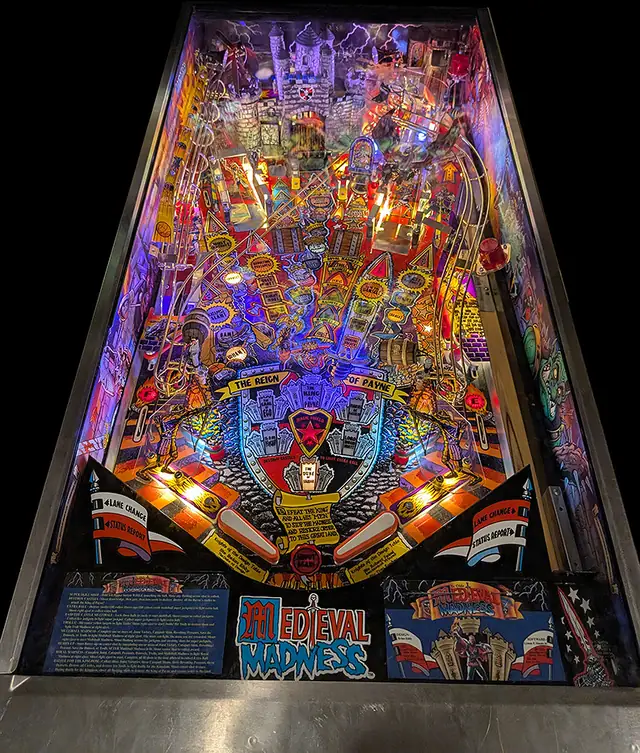
Silverball guide · Medieval Madness
The saucer that starts the multiball is the shot to avoid
Multiball Madness can only be played once per cycle, and both its ball count and its jackpots are priced on how many Madness lights you are holding when you start it. Starting it the moment it lights is the most common way to waste a good game.
Do not shoot Merlin's Saucer yet
Five things light a Madness: finishing Trolls, saving a damsel, scoring a peasant revolt, a catapult slam, and a joust victory. Any one of them lights Multiball Madness at Merlin's Saucer, which makes it very easy to start and very easy to start badly.
Everything about the round scales with how many Madness lights are flashing when you begin. One light gives you two balls; two to four give you three; all five give you four balls and an introduction the machine is clearly proud of. Each lit Madness turns its own shot from a jackpot into a super jackpot, and raises both values: jackpots run 75K plus 25K per Madness, supers 250K plus 150K per Madness. So a one-light Multiball Madness pays 100K a shot and a five-light one pays up to 1M.
And you only get one. Once you have played Multiball Madness you cannot play it again until you have lit all five lights and played Royal Madness. So the saucer is a shot to avoid, deliberately, until the board is as full as you can get it. The ramps are the easiest lights to collect; the orbits are not far behind.
The castle usually out-scores the multiball anyway
The source makes a claim that is easy to miss and worth acting on: the average value of a shot at the castle beats the average shot in almost any Multiball Madness. On the King's castle, the fourteen shots it takes to destroy it are worth 27 million between them, against super jackpots capped at 1M.
So a badly lit Multiball Madness is not a disaster; it is a reason to ignore the jackpots and pound the main entrance instead. You may shoot the castle at any time, including during any multiball, and once one castle falls you can start on the next immediately. Since balls rattling around a multiball rarely make castle progress by accident, deliberately banging at the castle through a multiball is how the later castles get done at all.
Six castles, and what they cost
The castle is a three-stage shot and every stage scales with which castle you are on. The Nth castle needs N hits to lower the drawbridge and N plus one hits to raise the gate, so the King's needs six and seven. Each gate hit pays 200K times the castle number, and 2M a hit on the King's. Destroying a castle pays 2M times its number, and 20M for the King's.
All six is worth at least 78 million, which is most of a good game on its own. The order of the King's Men is random but the King of Payne is always last. Destroying a default of two castles lights an extra ball at Merlin's Saucer.
One quirk worth knowing: if you finish Castle Crusher before the other five lights, the drawbridge stays open but the gate drops again, each hit paying 750K, with a 7.5M castle bonus behind it. That bonus makes no progress towards anything. And Battle for the Kingdom only lights in single-ball play, so destroying the King's castle during a multiball means waiting.
Start Trolls into the multiball, not before it
Hitting the troll standups either side of the main entrance a default of eight times lights Trolls at Merlin's Saucer, and eight more hits award a troll bomb. Trolls is thirty seconds to hit each troll three times, and note that three shots is one troll towards the Master of Trolls requirement of ten, not three.
The best thing you can do with it is start it at the same time as Multiball Madness. Completing Trolls during Multiball Madness instantly adds Troll Madness to the running round as though it had just started: every ball you have lost comes back, the ball saver returns, and every super jackpot is worth another 150K. It is also far easier to finish Trolls with three balls than with one, and you are not risking the ball to do it.
Troll bombs fire from the launch button and count as a hit on whichever troll is nearest death. They work during Multiball Madness, Royal Madness and Battle for the Kingdom, so hoarding a couple is worth more than spending them the moment you have them.
The hurry-up compounds, and it is where the extra balls are
The castle hurry-up starts at 1M and falls quickly to a floor of 250K, collected at the main entrance whatever state the castle is in. Taken singly it is small. Stacked it is not.
If a second completion lands while one is running, the hurry-up resets higher: two completions make it 3M, three 5.5M, four 8.5M, five 12M, and it goes to at least 25 million. The countdown speed does not change, so once you have a double going there is no real risk of it timing out.
The rule for when you get one is awkward and worth stating plainly. If a completion is what lights that Madness for the first time, it does not start a hurry-up; anything else does. In practice: before you have played Multiball Madness you only get a hurry-up by repeating something, and after you have played it you get one every time. Each hurry-up collected counts, so a 3M one counts as two, and ten of them light an extra ball.
The four collection lights, and the shot counts behind them
Four of the six blue lights are just repetition, and knowing the counts stops you abandoning one shot short. A damsel takes four right-ramp shots, the first three scoring 25K, 50K and 75K and the fourth feeding the window at the back; three damsels light Defender of Damsels. A peasant revolt is four left-ramp shots on the same escalation; three light Patron of the Peasants. A joust victory is three orbit shots, either orbit, and three victories light Joust Champion. A catapult slam is three catapult shots and three slams light Catapult Ace.
The catapult is the hard one, and it has a shortcut: the red standup at the back of the catapult area counts as a catapult hit in single-ball play, and since the ball drops into the catapult straight afterwards, one good shot from the right flipper gives credit for two. That turns three shots into two.
Royal Madness is an extra ball with a timer on it
Lighting all five Madness lights after you have played Multiball Madness lights Royal Madness at Merlin's Saucer. It is a single-ball round asking for ten shots inside twenty seconds: two to each ramp, two to the orbits, two to the catapult and one to each troll, with the timer resetting on every shot. Finish it and an extra ball is awarded immediately.
It comes with a ball saver despite being single-ball, so the right move is to take the catapult first while that saver is live. The lock shot spots one of the ten, starting with the catapult, and the catapult standup counts too, so the hardest requirement can be cleared without a clean catapult shot at all. Each first shot also awards the ordinary thing that shot awards, so Royal Madness feeds the six blue lights while you play it.
Battle for the Kingdom, and what it costs to repeat
All six blue lights light Battle for the Kingdom at the main entrance, in single-ball play only. It is a four-ball multiball: catapult, both ramps, both orbits separately and the lock, each worth a 2.5M battle jackpot. Clear them and the gate is down for six shots at 5M each, with both trolls raised to spoil your angle, and the only way to drop them is a troll bomb. This is what the hoarded bombs are for.
One more gate hit, then the main entrance, and it pays 50 million. Victory laps follow on every major shot at 500K, with an ultra combo worth double and climbing for the rest of the ball.
Then everything resets. A second Battle needs another ten trolls, another three each of damsels, peasants, catapults and jousts, and all six castles again, which is why it is described as harder than Attack From Mars' Rule the Universe.
A note on this source, and the machine you are standing at
This was compiled from a community rule sheet whose author is not recorded in our copy, written when the machine was new: it distinguishes the release ROM v1.0 from the sample games' v0.5, and notes that video mode does not exist on the earlier one.
That matters more here than on most machines, because one of the four Medieval Madness listings on UK floors is explicitly a Remake LE and the other three carry no edition at all, so the machine in front of you may be either. The layout, the shots and the structure above are what the remake reproduces, but this guide is written against the original's rules and code, so treat specific values as the original's. Almost everything quoted here is operator-adjustable in any case, and the source says so: the trolls required, the hits per troll, the damsels and revolts and slams and victories needed, the FIRE completions for video mode, and which stage of Castle Multiball lights an extra ball.
Where this came from
Silverball wrote this, but not from scratch: it was compiled against the published rules below and checked against them, rather than written up from one person’s games. None of the wording is theirs. Machines get code updates that move the right shot, so a guide has a date on it for a reason.
- Medieval Madness rule sheet (author not recorded in our copy)