Silverball guide · Pokémon
Story modes are not for points
Pokémon buries a small scoring engine under a lot of systems. The modes you play early are worth far less than the permanent multipliers they hand you, and knowing that changes the order you do everything in.
What a story mode is actually for
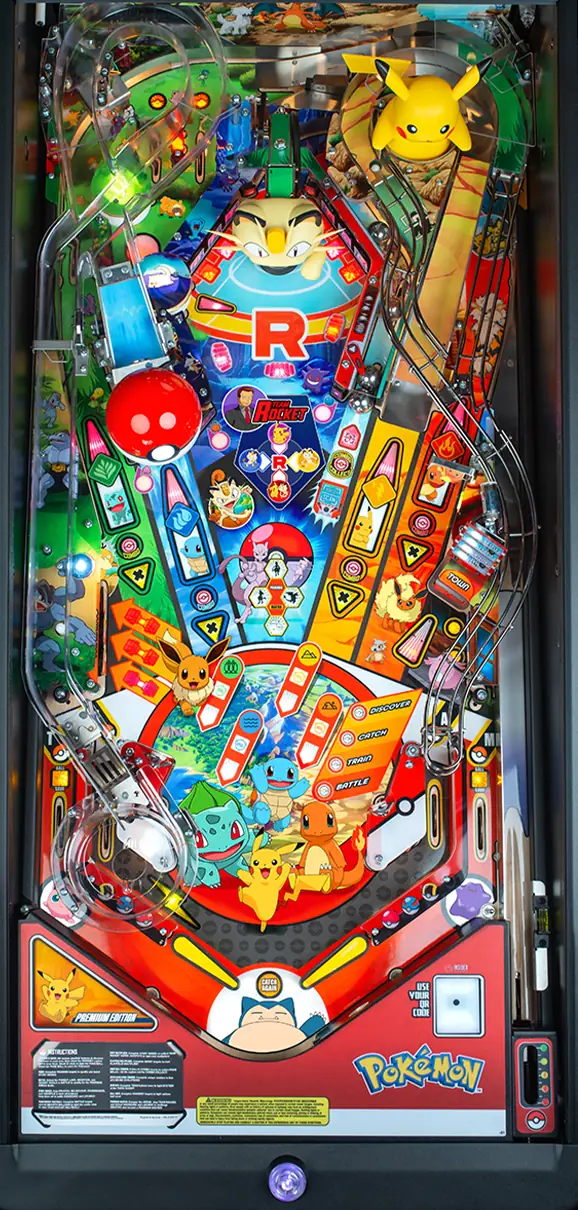
The two ramps and two orbits belong, left to right, to Bulbasaur, Squirtle, Pikachu and Charmander. Hit any of them three times in single-ball play and that character's story mode starts. The modes themselves are pleasant and not especially valuable.
What they pay is a shot multiplier. Complete a story mode and the next shot you make becomes 2x for the rest of the ball. Do that at every shot on the playfield and a further qualification starts handing out 3x instead.
That multiplier is not limited to modes. It applies to everything that shot scores: mode and multiball values, the CATCH! hurry-up, and the third shot of an Eevee evolution combo when it ends somewhere multipliable. So the correct way to think about the first half of a ball is that you are not scoring, you are installing multipliers on the shots you intend to use later.
The first super jackpot in any Team Rocket multiball qualifies one as well, which is the cheapest source of all.
TEAM features boost a shot for the rest of the ball
Completing the TEAM bottom lanes lights a feature, and the four arrive in a fixed order: Pikachu Hurry-Up at the right ramp, Squirtle Prize Pool at the left ramp, Charmander Super Spinner at the right orbit, Bulbasaur Loops at the left orbit.
Each is a short timed mode, and here is the part worth knowing: whether you complete it or let it time out, that shot's value is boosted for the rest of the ball, and combos through it award an extra Poké Ball. There is no penalty for a feature you fail to finish.
They can also start during multiball, which makes them worth collecting whenever the lanes come round rather than saving for a quiet moment.
The berries, and when to start 2x playfield
Hit the left and right berry targets twice each, then the centre berry target while it flashes, and 2x playfield runs for 20 seconds. Pikachu's cheeks light above the flippers to show the timer.
You can add time by hitting the centre berry again while it is running, five seconds a hit, but never past the 20-second ceiling. In practice that means topping it up is only useful if you have already burned most of the window.
Since it is short and capped, treat it as something you start before a big collect rather than something you keep alive. Twenty seconds of 2x on a shot you have already multiplied is a very different number from twenty seconds of 2x on whatever happens to be lit.
Travel is a checklist, and it gates everything
You begin in the forest biome. To move on, complete the three tasks listed above the right flipper: discover and then catch a Pokémon, complete the training targets outside a story mode, and play a rival battle. Then shoot the town scoop, while nothing else is running, and choose where to go next.
Do that for all four biomes and the scoop starts the Arena Battle. There is no way round the checklist, so if the Arena is the game you want, the tasks are the game you have to play.
Rival battles get progressively harder to light. The forest battle needs one capture, the second biome needs two more after that, the third needs another three, and it caps there.
Catching, and the one shot you have to make yourself
Outside modes and multiball, switch hits fill a gauge, mostly from the top lanes and the bumpers. Fill it and a Pokémon appears to be scanned at the captive ball. Scanning starts a short ball save and a hurry-up from 2 million.
From there you shoot the purple targets to spell CATCH!, which lights the Poké Ball shot at the left ramp for a value starting at the combined total of everything you just collected. Which purple targets are lit depends on how many Pokémon you have already caught, so the sequence lengthens as the game goes on.
A Pokedex Assist will spot the currently lit purple shot and award its value. It will not spot the final left ramp shot, and it will not spot the victory bonus at the same ramp after a battle. Those two you make or you lose.
The captive ball repays hitting it out of multiball
Shots to the Pokedex captive ball advance towards a Pokedex Assist, used by pressing the action button while it blinks red. Progress is deliberately easier in single-ball play.
It is also an extra ball. Twenty-five captive ball hits in a game lights it at the town scoop, and the accounting rewards playing it properly: in single-ball play every switch counts individually and a full-strength shot can register up to three, while during multiball each hit counts as one no matter how hard you shoot.
So the captive ball is a single-ball job. Hammering it during a multiball is close to a waste of the shot.
Rival battles: types, switching and healing
You always start a battle as Pikachu, an Electric type. After dealing three shots of damage the town scoop flashes and you can switch Pokémon, choosing with the right flipper. If one of your team is super-effective against what you are facing, its insert flashes faster than the others, so the machine is telling you the answer.
The training targets do three different jobs depending on when you hit them, and this is the detail most players never separate. Outside a story mode they train one of your four Pokémon so it deals more damage in battles. During a story mode they add 20 seconds to the timer. During a rival battle they heal your active Pokémon, once per Pokémon swapped out.
The battlefield targets build an arena bonus you cash at the centre lane; everything else you shoot is multiplied by your shot multipliers and boosted by any TEAM features you have completed. Winning lights the left ramp for a victory bonus based on how quickly you finished, and it is only lit for ten seconds.
Combos are an extra ball in disguise
Every combo shot awards a Poké Ball, and one more if the shot has been boosted by a TEAM feature. Make a two-way combo or better and the captive ball lights to finish it, paying Poké Balls equal to the length of the combo, so a five-way ending at the captive ball is worth five.
Collect 50 Poké Balls in a game and the extra ball lights at the town scoop. They also feed the end-of-ball bonus, and the mystery award hands out between two and ten at a time.
On top of that there are eight hidden Eevee evolution combos, each worth 2.5 million plus 500,000 per unique combo already made. Collect all eight for 10 million, after which they reset and can be scored again at the value you have built. Vaporeon is left ramp, right ramp, battlefield. Jolteon is right ramp, left orbit, centre playfield multiplier target. Espeon is right ramp, left ramp, captive ball. They are worth learning two or three at a time rather than all at once.
Where the cabinets differ
Squirtle's story mode multiplies ramp shots on a Pro and whirlpool spins on a Premium or LE, which is the same rule expressed through different hardware.
Squirtle Prize Pool is the clearer split. On a Premium or LE you shoot the left ramp, the ball spins in the whirlpool, and you press the action button to take the award showing at that moment, doubled. On a Pro there is no whirlpool to choose from, so a set value is scored instead.
The Psyduck sneak-in above the training targets is a standup target on a Pro and a scoop on a Premium or LE. On the Premium and LE it also runs a short ball saver after releasing the ball, with no grace period, so a drain immediately after that saver expires is genuinely lost.
Where this came from
Silverball wrote this, but not from scratch: it was compiled against the published rules below and checked against them, rather than written up from one person’s games. None of the wording is theirs. Machines get code updates that move the right shot, so a guide has a date on it for a reason.
- Pokémon community rule sheet (author not recorded in our copy)