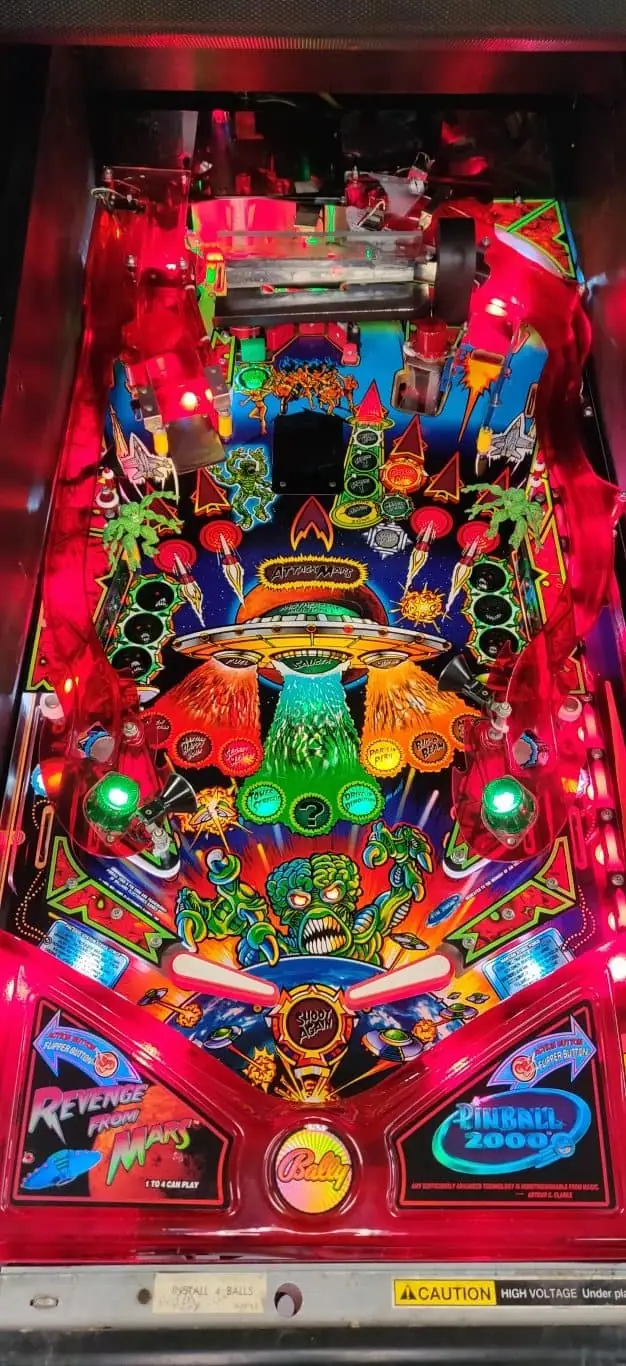
Silverball guide · Revenge from Mars
Complete is not the same as Flawless
Nine modes start themselves, run once and never come back. Only the ones you finish Flawlessly light a saucer, and the machine keeps offering you a shot that ends the mode before you have earned it.
The rating, not the completion
Attack Mars is the game, and three things light it: all nine saucer lights, the three Bonus Wave multiballs, and Mothership Multiball. The saucer lights are where most games are lost, because the obvious route to them does not work the way it looks.
Finishing a mode is not what pays. Finishing a mode with a Flawless rating is. The video prints a report when a mode ends, and only a Flawless report awards a saucer light; anything less awards points and nothing else. There is no start-mode shot and no way to pick a mode over again. The modes advance in sequence on their own as each one finishes, and an unfinished mode carries between balls, so a mode you completed scruffily is a saucer light gone for the rest of the game.
That is the whole discipline on this machine. Every mode has a condition printed into it that decides the rating, and it is almost never the same as the condition that ends the mode.
The centre ramp is usually a trap
When the centre mini ramp pops up, the machine is offering to end the mode. Take it too early and the rating goes with it.
In Martian Happy Hour, Flawless means all five martians destroyed, but setting off all three kegs blows up the bar and ends the mode on the spot. The kegs are worth 4M each at the orbits and 6M in the centre, so they are tempting, and they will finish the mode out from under you unless the martians are already dead.
In Mars Kneads Women the display tells you outright that the next centre ramp shot will destroy the console and end the mode, and Flawless needs all six television screens watched. In Big-O-Beam, depleting the saucer's life bar raises the ramp, but Flawless needs the cow, the duck, the pig and the chicken shrunk. Shrink all four and the ramp comes up anyway, so the animals cost you nothing. In Paris in Peril the saucer can be destroyed on damage alone, and Flawless needs the four parachuting martians. Tower Struggle behaves the same way: the tower's life bar ends it, the four targets rate it.
So the question to ask when the ramp rises is not whether you can hit it. It is whether you have already done the thing the rating is counted on.
The other ways to a saucer light
Nine modes and nine lights leaves no slack, so it is worth knowing the alternatives. A Super Jackpot in regular multiball awards one. Martian Multiball awards one at ten martians destroyed and a second at around thirty, both operator-adjustable. The Bonus Wave multiballs award them on the item table. A Stroke of Luck award can simply hand you one.
None of these are as cheap as a mode you were going to play anyway, which is why the Flawless discipline is worth the trouble. But they are why a game with two scruffy modes in it is not over.
Choose your group before the ball is in play
At the start of a game the action buttons choose which of the two outer mode groups you begin in, Fuel or Weapons. You have about ten seconds; ignore it and the machine alternates the default from the last game's choice. The middle group, Saucer, is not offered until the other two are finished.
The source rates Big-O-Beam as one of the higher-scoring modes and a good one to open on, and it sits in the Weapons group. Secret Weapon is named as one of the easier Flawless ratings to get, in Fuel. Either is a reasonable opening; the point is that this is a decision and most players let it time out.
Take the super skill shot every time
The ordinary skill shot is the lit rollover lane for 500K, rising 100K each time you collect it. The super skill shot is worth more than the difference in points suggests: hold the left flipper button while the ball launches, and it bypasses the lanes entirely, comes round the left orbit and arrives at the left flipper. An orbit or ramp within about ten seconds pays 1M, rising 200K each time.
It also spots three missiles, and that is the real reason to do it. If the ball ends up in the lanes anyway the regular skill shot still scores, so the attempt costs nothing.
Missiles are the quiet scoring
During modes, the orbits and the ramps award missiles as well as doing whatever the mode wants. The first missile on a ball is worth 500K and each one after adds 100K, resetting to 500K at the start of the next ball. Twenty missiles lights an extra ball at the Stroke of Luck scoop, and so does fifty; thirty pays 5M.
The escalation is per ball, so a long ball turns missile shots into some of the best scoring on the machine. They also feed the mode you are in rather than distracting from it: missiles destroy the small saucers in Alien Abduction, set off the kegs in Martian Happy Hour, and do a quarter of the damage needed in Paris in Peril.
The multiballs interrupt, and that matters
Unlike Attack From Mars, Martian Multiball and regular multiball are mutually exclusive here, and either one interrupts the mode you are running. The mode is not lost, it waits, but you will not be making progress on it.
Regular multiball comes from the third Capture. Ten saucers on the upper playfield are worth 500K at the centre targets, 1M at the Capture lane and martian target and 1.5M at the ramps, and they build the super jackpot. Five hits on the big saucer that appears afterwards awards the super jackpot and a saucer light, once only; the cycle repeats without a further light. Martian Multiball follows Martian Attack, and every shot kills a martian for 1M.
The Bonus Wave multiballs are the ones to prepare for. Each follows a completed mode group, runs four balls, and carries a 2X that floats on a shot and can be moved with the action buttons. Shoot the 2X where it stands and it doubles that shot and its items, and it will not go back to a shot you have already doubled. Cover all four of the centre, both ramps and the lock and it becomes 3X, with every shot available again, up to a maximum of 5X. Items are cumulative across all three of these multiballs, and forty of them on the medium setting lights Mothership.
Attack Mars, and the buttons you have been ignoring
The reward is worth the setup. The source describes it as the point where a 300M game becomes a 600M one, and the final shot alone pays over 100M.
It runs in three stages and every one of them uses the action buttons while you are also flipping: three ships to line up on radar and destroy through the middle shot, four objects to steer into the main shots, and then the Big Brain martian, hit through the middle and finished on the raised centre ramp. Balls do not drain between stages. The buttons are the difficulty, which is why it is worth having used them earlier in the game rather than meeting them here.
A note on this source
This was compiled from a community rule sheet whose author is not recorded in our copy, written against software revision 1.2 on a machine from 1999. Our credit names the document rather than a person for that reason.
Several values on this machine are operator-adjustable and the sheet says so: how many martians a mode needs, the number required for a saucer light in Martian Attack, the damage each catapult hit does in Paris in Peril, the first Bonus Wave award, tilt warnings, and the difficulty setting itself, which runs from Extra Easy to Extra Hard and defaults to Medium. The source also marks several values as uncertain, and those have been left as gaps here rather than filled in.
Where this came from
Silverball wrote this, but not from scratch: it was compiled against the published rules below and checked against them, rather than written up from one person’s games. None of the wording is theirs. Machines get code updates that move the right shot, so a guide has a date on it for a reason.
- Revenge From Mars rule sheet (author not recorded in our copy)