Silverball guide · Rush
The combos are not a side game
Rush looks like six song modes with a combo game bolted on the side. It is the other way round: the 1-2-3 combos hand you albums, albums arm The Weapon, and The Weapon is what finishes a song mode.
Stack albums, do not cash them one at a time
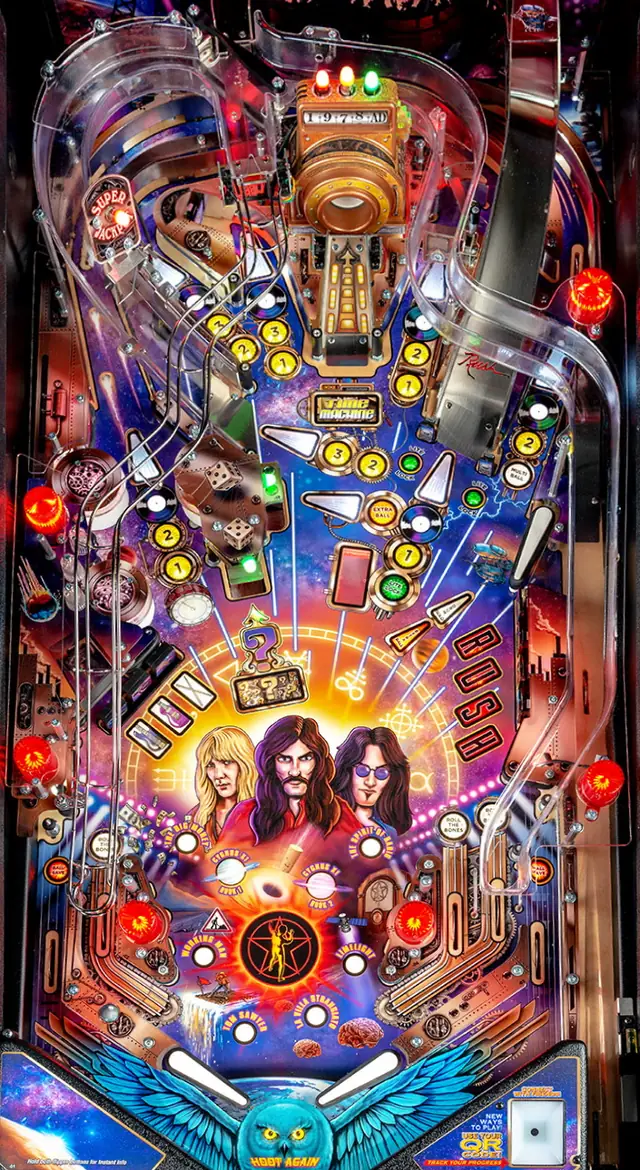
There are ten album combos, each a particular order of shots, signposted by the 1-2-3 inserts around the playfield. Shoot a lit 1 and the 2s light; shoot a 2 and the 3s light. Do it inside the combo timer and the combo value doubles. Finish a 1-2-3 and the Time Machine lights to collect that album and its Combo Jackpot.
Here is the part worth changing your game for. The Combo Jackpot is the sum of every combo you made leading up to it, multiplied by how many albums you collect at once, and albums stack at the Time Machine waiting to be collected. Cashing each album the moment it is ready throws that multiplier away every single time. Collect the jackpot and the side ramp lights briefly for a Combo Super Jackpot worth twice what you just took, so the stacking is doubled again on the way out.
Albums also raise combo values permanently, so the game gets better at paying the longer you play it this way.
What an album actually buys
Collecting an album qualifies The Weapon for the songs on it. If you are in a song mode and hold that song's album, the action button flashes blue, and using it spots every shot on the playfield, scoring all the mode and multiball awards sitting on those shots at once. If you are in a multiball song, it flashes green and adds a ball instead.
The order the shots are spotted in follows the ramp diverter: set for the left return lane it spots left to right, set for the right it spots right to left. That is a genuine decision when a mode is priced on which shots you reach first.
You pick the song, and the same choice sets your multipliers
Records light the six main song modes. Which mode starts is decided by which colour of record you collected the most of: cyan is Tom Sawyer, orange Working Man, blue The Spirit of Radio, pink The Big Money, purple La Villa Strangiato, lime Limelight. Shoot the Time Machine once you have enough and that mode starts.
The records are not just a vote, though. Records of the mode's own colour become 2x shot multipliers for the whole mode, and starting a mode with all six locked in makes all six shots 3x. Records collected after the mode is lit keep boosting its value, with matching colours staying locked. Album colours rotate on the RUSH standup targets and on collecting any record, so the colour you end up with is steerable.
The modes are untimed. They end when you complete them or when you drain, so the cost of starting one is your ball, not a clock, and there is no reason to rush a mode you are winning.
What the six songs are counted on
The songs differ less in their shots than in what finishes them, and that is the thing to know before you choose one. Tom Sawyer is three phases of shots. Working Man is a clock from nine to five, nudged by any switch and advanced properly by lit arrows, most of all the left orbit, side ramp and side loop. The Spirit of Radio keeps the spinner and the top left lane lit throughout, the spinner growing both the Radio Jackpot and the number of shots feeding it, the top left lane cashing it, five times over.
The Big Money runs waves of three, four and five shots to light a jackpot at the Time Machine, and its trick is that you can re-shoot the shots that lit it to raise the multiplier before you collect. La Villa Strangiato is twelve shots taken strictly one at a time, each leading to the next on a short combo timer that multiplies the awards. Limelight is the odd one out: every arrow starts a fifteen-second countdown, after which your fame is gone and the Time Machine has to be shot to get back into it.
Start the song first, then the multiball into it
Shooting the Time Machine with nothing else lit builds towards one of three multiballs. Which one is lit is shown by the flasher: a normal blink is Red Barchetta, a fast blink Subdivisions, a slow pulse Fly By Night. The Dead End shot to its left changes which is lit, so this is a choice rather than a draw.
The order matters because the rules are asymmetric. Starting a Time Machine multiball blocks you from starting a song mode, but starting a song mode does not block multiball progress, and a Time Machine multiball can be started during a song. Start the song first and you can have both; start the multiball first and the song has to wait.
The three Time Machine multiballs
Red Barchetta prices its jackpots on your RPM, which jackpots raise sharply and any switch raises a little. Redline it to light the pops, hit enough of them for a super jackpot worth the sum of your jackpots, and shift up, which raises every value and relights every shot. Sixth gear is victory laps, where any jackpot relights the rest.
Subdivisions starts with only the Time Machine lit and spreads: each jackpot lights the two nearest shots either side of it, wrapping round the playfield, and once every main shot has been lit the super pays the sum of everything collected since the last one. Fly By Night dims the machine as you play, switch hits turning the illumination down and lit arrows dimming it further, until the lights are out and the super is lit.
Far Cry gets harder every time, and the instruments do not
Far Cry locks escalate with every multiball: the targets beside the right ramp, then the ramp as well, then that ramp on a timer, then both targets twice with the timer shortening each time. From the third multiball on it must be started at the side scoop, which is worth doing from the first, because starting there starts the jackpots higher.
In the multiball the shots are lit at 1x through 5x, and the higher the multiplier the faster it times out. Any jackpot grows the base value and refills the board at fresh multipliers, but let every shot time out and the base value resets to nothing. Enough jackpots lights the super at the Time Machine, and taking it adds three balls for One Little Victory laps.
The instruments run on their own clock. Time your first shot to the drop targets to lock in bass, guitar or drumsticks, or cycle it at the lane behind the bank before you finish the targets: bass raises combo values, guitar the spinner, drumsticks the pops, and drumsticks also light Drum Solo under the flipper. Shooting that lane activates what you hold and doubles its effect, but every instrument shares one timer and activating a second resets the timer for both, so feeding them in one at a time is exactly how the perk gets wasted. All three collected lights Freewill Multiball, where you choose which jackpot becomes the super, and the super grows with each different shot you use for it.
The clock, and where the extra balls are
The pop bumpers advance a clock by their colour, from a minute a pop for white to four or more for red, and midnight lights the right orbit for Headlong Flight, whose jackpot is priced on the time showing. Drum Solo doubles every pop's minutes while it runs and its own value can be built up with pop hits before you start it, which is the efficient order. Each hour crossed lights the left orbit for a drum bonus built from those same hits.
Completing the RUSH targets lights the Bastille Day hurry-up, where hitting a target collects its value and raises the other three by that amount, and completing the bank enough times lights an outlane save you can move with either flipper button. Extra balls come from a ramp count and from collecting five albums, which is one more reason the combo game is the game.
Two wizard modes that sound alike and are not
Cygnus X-1: The Voyage asks you to START all six multiballs: the three Time Machine multiballs, Far Cry, Headlong Flight and Freewill. Cygnus X-1: Book 2 asks you to COMPLETE all six core song modes. Starting and completing are the whole difference, and they pull a game in opposite directions.
Beyond both sits 2112, reached by performing well enough in modes and multiballs to add years to the time machine until you reach the year itself.
Where the cabinets differ
Rush stands on UK floors as a Pro and as a Premium, and our source is Stern's Pro sheet, which does describe the differences. On a Premium or LE the Time Machine ramp is down and raises when it has been bashed enough, and the ramp's runway lights show which multiball is lit: red lights for Red Barchetta, alternating halves for Subdivisions, and lights roving upward for Fly By Night. On a Pro that information comes from the flasher pattern and the display instead.
Freewill starts differently too: on a Premium or LE the ball is locked while you bash up the jackpot values before it is released. The Premium and LE also have a vertical up-kicker to help with the Roll the Bones return lanes. Nothing else in this guide changes between the two.
A note on this source
This was compiled from Stern's own rule sheet for the Pro. That sheet carries almost no point values, describing what qualifies what and in which order rather than what anything pays, so this guide is about shape and sequence and stops where the source does.
Rush is a modern machine on code that has continued to change since the sheet was written. Treat the structure as reliable and any specific behaviour as worth checking against the machine in front of you.
Where this came from
Silverball wrote this, but not from scratch: it was compiled against the published rules below and checked against them, rather than written up from one person’s games. None of the wording is theirs. Machines get code updates that move the right shot, so a guide has a date on it for a reason.
- Stern Pinball, Rush (Pro) rule sheet