Silverball guide · Star Wars
Multipliers first, missions second
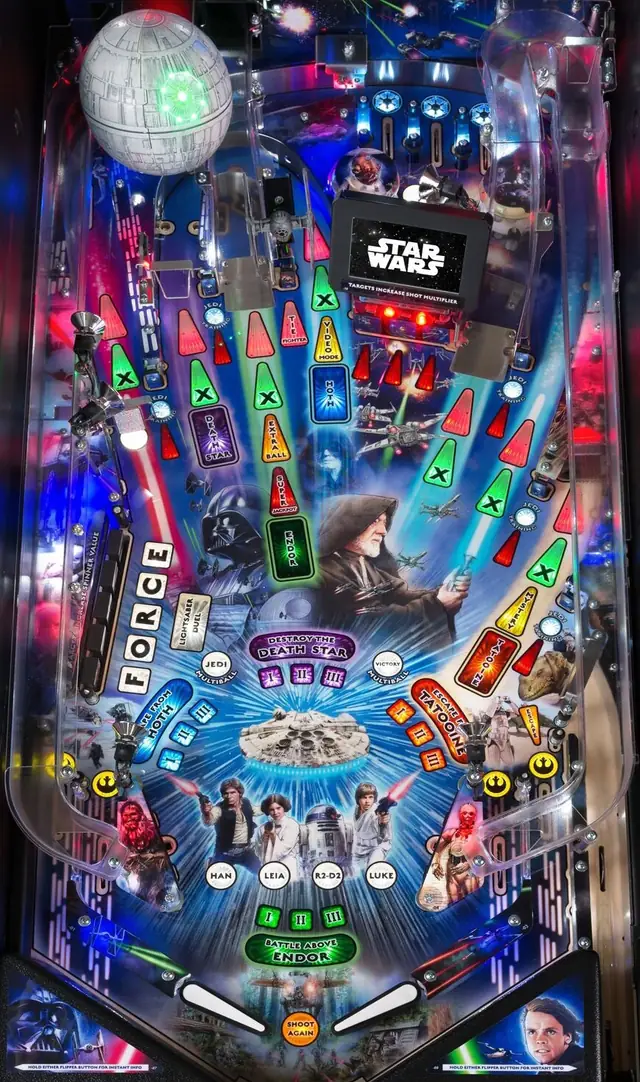
Star Wars hands you four characters, four planets and a wizard mode, and none of it scores properly until you understand that a small bank of standup targets in the middle of the playfield decides what everything else is worth.
The three-bank decides what everything is worth
The standup targets in the centre of the playfield run the shot multipliers, and the shot multipliers are where the big scores on this machine come from. Multipliers start at 2x, and every hit on the three-bank adds another x, up to 20x. The fourth FORCE award doubles the lot, so the true ceiling is 40x on a shot.
You control where they sit. The action button toggles them on, shown green, and off, shown red; while they are off the flippers move them left and right along the playfield. That is the whole skill: park the multiplier on the shot the current mode wants, switch it on, and take the shot.
The catch is that the spread narrows as the multiplier climbs. At low values three shots carry the green X. At 5x it drops to two. At 10x only one shot is multiplied at all, so a high multiplier aimed at the wrong shot is worth nothing. Playing as R2-D2 pushes those thresholds out to 7x and 14x, which is a real advantage.
And it decays. If the three-bank has not been hit for a while the multiplier resets to 2x, and the higher it is the faster it times out. Backhanding the bank from the left flipper is the reliable way to keep it alive, and it is worth learning as a shot in its own right rather than as something you do when you remember.
Choose a character for the game you intend to play
At the start of the first ball you pick from Luke, Leia, R2-D2 and Han Solo. This is not cosmetic. The choice changes which planet modes exist for you at all, and it hands you one permanent benefit.
Luke doubles the scoring in Lightsaber Duel. Han doubles Escape from Boba Fett. Both of those only pay if you actually finish the mode in question, which most players do not. Leia adds 3x to the shot multiplier during any final planet mode, and R2-D2 makes multipliers easier across the entire game: fewer target hits needed, and they last longer before decaying.
If you accept the argument in the section above, then Leia and R2-D2 are the characters that make your ordinary play worth more, and Luke and Han are the characters that make one mode worth more. New players are usually pointed at Luke and R2-D2 as the friendliest, and R2-D2 is the one of those two that also happens to be the strong pick.
Separately, at the start of every ball you get a path of four awards to choose between with the flippers. It locks in the moment the ball enters play, so decide before you plunge rather than after.
Modes do not time out, so stop rushing them
Shoot any of the four planet shots three times to qualify that planet, then shoot it again to open a menu of that planet's modes. Death Star is the left mini-loop, Endor the left ramp, Hoth the right mini-loop, Tatooine the right scoop.
The modes themselves do not run on a clock. Plenty of them are built around short hurry-ups inside the mode, but the mode will sit there and wait for you. That changes the correct way to play them: there is no reason to force a shot, and every reason to go and reset your multiplier on the three-bank first.
Two modes from different planets can run at once, which is worth setting up. The final multiball for each planet must be played on its own, and the number of balls it starts with is one more than the number of modes that planet made you play. Winning two missions lights an extra ball at the left ramp.
The two easy multiballs are not where the points are
TIE Fighter Multiball pays jackpots of 750,000, with a super at the left ramp starting around 4 million. Hyperspace Multiball is in the same territory. Compared with a final planet multiball played under a stacked multiplier, both are small.
So treat them as backup rather than as objectives. The right time for either is underneath a final planet multiball, where they refill the playfield with balls and reset a ball saver while the mode carries the scoring.
That does not mean ignoring TIE Fighters. They are the qualifier for a lot of the game. Cash the hurry-up at the TIE Fighter target and then hammer the action button through the seven-second window; destroying 80 lights an extra ball and destroying 100 is a requirement for the wizard mode. Just do not risk a drain doing it. Work out where the ball is going before you commit both hands to the button.
Hyperspace is lit by completing the inlane rollovers, which cycle with the flippers. It is cheap progress that costs you nothing to collect on the way past.
Lightsaber Duel is a trap you can walk into
The FORCE targets pay five awards in a fixed order: Mystery, Escape, Video Mode, Double Multipliers, and finally Lightsaber Duel. The fourth is the one you actually want, because doubling the shot multipliers is the single biggest scoring lever in the game.
The fifth is a problem. Lightsaber Duel only starts when nothing else is running, but once started it takes priority over everything and carries between balls until you finish it. Worse, no further FORCE awards can be collected until it ends. Players call the resulting state Lightsaber Duel jail, and it is a real way to lose a good game.
Two things follow. First, try to get Double Multipliers working during a mode where it will pay, rather than collecting it in dead time. Second, be aware that Jedi Training pushes you towards the duel whether you meant to go there or not, because each Jedi Training level advanced also completes a set of FORCE targets.
Jedi Training pays twice over
Complete every blue standup target on the playfield within about thirty seconds to advance a Jedi Training level. The ladder runs Youngling, Padawan, Jedi, Master, and the numbers are not close: Youngling is 250,000 for the completion and 25,000 a target, while Master is 25 million a completion and 2.5 million a target.
It also feeds the end-of-ball bonus, and becoming a Jedi Master is one of the five requirements for the wizard mode. That combination makes it the best thing to be doing early in a game, before you have anything better to shoot at.
The bonus itself is largely switch-based, but it also counts your training level and how many planet modes you played this ball, all multiplied by the bonus multiplier from the skill shot and the top lanes. Bonus Hold from Mystery holds both the bonus and the multiplier, and collected on the last ball it pays the bonus twice.
In Victory Multiball, chase the medals
Finishing a planet's final multiball mode starts Victory Multiball, which throws in three more balls. The obvious goal is the six major shots for points. The less obvious one is the medals, which run bronze, silver, gold.
Medals decide the bonus you are paid at the start of Jedi Multiball, and that bonus is frequently worth more than the wizard mode itself. If you are going to reach the wizard mode at all, the medals collected several balls earlier are what determines whether it is a big score or a formality.
Once Victory Multiball ends, that planet is closed off until the wizard mode has been played.
Where the cabinets differ
The lock for Hyperspace Multiball is not the same machine to machine. On a Pro the ball is locked at the left mini-loop and must be knocked back out to set the jackpot value, and you can run the sequence a second time for a bigger one. On a Premium or LE the ball loops around the hyperspace wireform instead, and sending more balls into it raises both the jackpots and the number of balls the multiball starts with.
Escape, the second FORCE award, also differs. On a Pro it is a virtual ball save at the right outlane. On a Premium or LE a gate opens and physically returns the ball to the plunger, which means you get another plunge out of it.
Everything else above holds on all three cabinets.
Where this came from
Silverball wrote this, but not from scratch: it was compiled against the published rules below and checked against them, rather than written up from one person’s games. None of the wording is theirs. Machines get code updates that move the right shot, so a guide has a date on it for a reason.
- Star Wars community rule sheet (author not recorded in our copy)