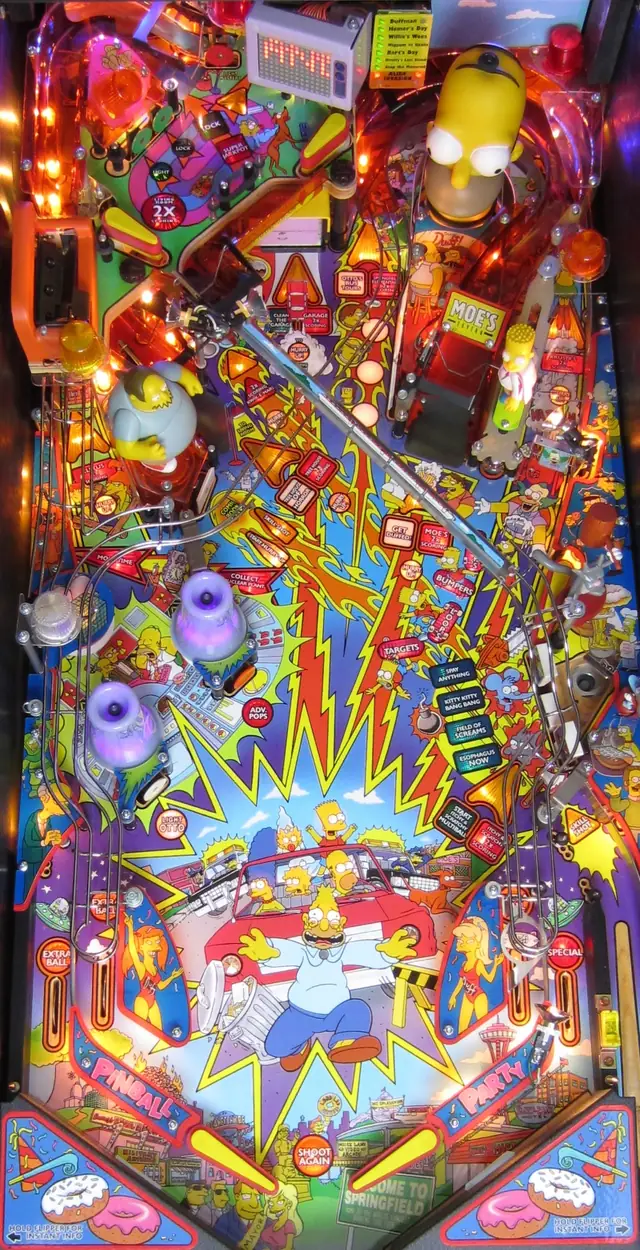
Silverball guide · The Simpsons Pinball Party
There is only one timer, and it is the whole game
Every timed thing on this machine runs on a single shared clock, and starting anything new resets it to thirty seconds. Keep feeding it and everything you have started keeps running, which is how a frenzy mode lasts ten minutes.
One clock to rule them all
Every timed mode here shares one timer, shown on the TV board and colour-coded as it runs down. Starting any timed mode resets that timer to thirty seconds if it is not already higher. It does not reset when a mode completes, and it keeps running through multiballs and everything else.
The consequence is the single most important thing about the machine: as long as you start something else within thirty seconds, everything you have started since the clock began keeps running. There are at least twenty things that reset it, so a D'Oh Frenzy can run for over ten minutes.
Any of the ten Otto double scoring modes will reset it, as will any of the seven TV modes, D'Oh Frenzy, and the timed Treehouse of Horror modes. The source's own reminder is the one to keep: at most points in the game you are two shots from a reset, because you can hit the Lite Otto standup and then shoot it. There is about a three-second grace period when it reads zero.
Feeding the clock from the bumpers
The timer stops while the ball is in the bumpers, so the pops are a safe place rather than lost time. The Pop Target above them puts time back, and how much depends on how you hit it.
Hit it after bouncing off a bumper and you get two seconds. Hit it directly from a flipper and you get five. Hit it from the upper right flipper as a combo out of the Left Loop and you get ten. That combo is the most time available from a single shot anywhere on the machine.
Victory Points can beat a multiball
Complete a TV mode and something quiet starts happening: every major shot you make while the timer is on scores Victory Points, priced on how many TV modes you have completed in the current run. One completed mode is 100,000 a shot, two is 250,000, and it climbs from there past a million.
Double scoring applies on top. The source's estimate is that skilful play can make every major shot worth at least two and a half million, and says outright that this can be worth more than a well-played multiball. It only pays while the timer is running, which is the second reason to keep feeding it.
You can also choose which TV mode comes next by flipping the right flipper, and starting one pays an instant 250,000. The seven are lit at the right orbit and started on the TV Loop upstairs.
Otto's double scoring is ten separate modes
Hit the Lite Otto standup when lit, then shoot the Right Loop when Otto's Bus Tour lights, and a double scoring mode begins on one of ten areas: the bumpers, both orbits, both ramps, both loops, the Garage, Itchy and Scratchy, and the entire upper playfield.
A flashing red light means that area's double scoring is currently running; solid means it has been used and will not return until all ten are done. It doubles every shot to that area, including during TV modes and multiballs, and like everything else it lasts as long as the timer does.
Complete all ten and the red lights pulse rather than sit solid. One more Otto shot then starts something the source keeps for its spoilers section, and it is worth reaching without being told what it is.
Stack the hurry-ups rather than taking them singly
Shooting Comic Book Guy starts a hurry-up at one of six major shots, counting down from 200,000 to 50,000. Hit him again and a second hurry-up runs at the same time.
Running several at once raises the starting value considerably, though they count down faster, and collecting one adds to the value of the others still running. So the efficient play is to light two or three before collecting any. A plunge that hits Comic Book Guy is a skill shot and starts two immediately.
As with the double scoring lights, a collected hurry-up stays solidly lit until all six are done, after which they pulse and one more Comic Book Guy shot starts something else the source hides in its spoilers.
Two multiballs with very different entry costs
Couch Multiball is the friendlier one. Locks are lit with the Lite and Lock standups and collected on the upper playfield ramp, and in a single-player game you get free credit for any balls already sitting in the couch when you start. Jackpots climb from 200,000 to a cap of 500,000, the Treehouse ramp pays double, the TV Loop triple, and the Couch Ramp a super worth five times the jackpot which also relights everything.
Itchy and Scratchy Multiball punishes carelessness. You must clear the whole three-bank, shoot the hole, clear the bank again, then shoot the hole to start it. Only the first multiball is forgiving. After that, shooting the hole without having cleared the bank gives you no progress at all and resets the targets, so a stray shot into the hole undoes the work.
D'Oh Frenzy is the payoff for all of it
Letters in SIMPSONS come from opening the Garage, shooting the Garage mini-ramp, or shooting the Treehouse ramp, and two at once from a Treehouse ramp taken straight after the Cletus orbit.
Spell it and every switch on the machine scores: 10,000 each on the first frenzy, 2,500 more per switch on each one after. It ends only when the timer expires or the ball does.
This is where the shared timer stops being a curiosity and becomes the strategy. A frenzy paying ten thousand a switch, running for minutes because you kept starting things, with double scoring active on the area you are shooting, is the biggest thing on the machine.
A note on this source
This was compiled from a rule sheet whose author is not recorded in our copy and which describes itself as preliminary. It marks its own uncertainties in square brackets and asks readers to write in with corrections.
Those uncertainties have been left out rather than tidied up. The exact shot counts in a couple of TV modes, the jackpot increment in Couch Multiball, the starting value when several hurry-ups run together, and the number of completed TV modes needed to reach the top Victory Point value are all flagged as unknown in the source, so they are not stated here. The structure, the timer rules and the scoring that the sheet is confident about are what this guide is built on.
Where this came from
Silverball wrote this, but not from scratch: it was compiled against the published rules below and checked against them, rather than written up from one person’s games. None of the wording is theirs. Machines get code updates that move the right shot, so a guide has a date on it for a reason.
- The Simpsons Pinball Party rule sheet, marked preliminary (author not recorded in our copy)