Silverball guide · Wheel of Fortune
The centre ramp is a reroll
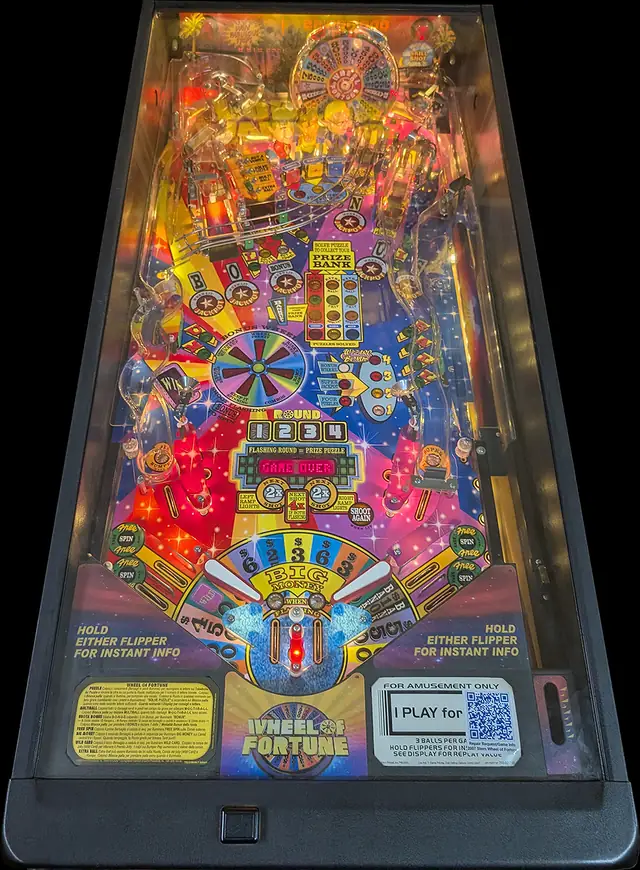
The wheel sets the numbers your modes pay, and two of its wedges are worth nothing at all. The centre ramp spins it again. Knowing that turns a machine that feels like a slot machine into one you can actually play.
The wheel decides almost everything
Three coloured arrows sit at the top of the wheel, one for each contestant, and where they land is what that contestant pays. Twenty four wedges, and the values are randomised from game to game rather than fixed.
Most are points. Some add a prize to a contestant's bank. Two are actively bad: Bankrupt strips all points and prizes from the contestant it lands on, and Lose A Turn stops that contestant being used to guess a letter until the wheel is spun again.
So spin it again
During most bonus wheel modes, the values the three contestants are sitting on are the values in the mode, and Bankrupt and Lose A Turn count as zero.
Shooting the centre ramp spins the wheel to a new set of values at any time. If you start a mode and two of your three contestants are parked on dead wedges, you are not stuck with it. That single fact is the difference between this machine being random and being playable.
Ramps double, and both ramps quadruple
Shoot either ramp and the next shot you make is worth double. Combo both ramps, which requires the right three drop targets to be down first, and the next shot is worth four times.
Line that up with a large wheel value or a jackpot and it is the biggest single thing you can do here. It also means the ramps are rarely the shot you actually want to score with; they are the shot you take immediately before the one you do.
Free spins are a ball save that accumulates
The outlanes each hold two rollovers that can be lit for Free Spin once the first drop target has been hit. A drained ball that rolls through a lit one is instantly relaunched.
They carry between balls. Drain without using one and qualify them again next ball and you can have all four lit at once. With practice you can nudge a draining ball into the correct lane, which is the only ball save in pinball you can aim.
The main multiball, and its escalating price
Nine MULTIBALL standups are scattered around the playfield. The first time, any hit gives you a letter whether or not you have collected it before. The second time, every letter must be hit once. The third time, twice each.
It is a three ball multiball with four shots lit for jackpots starting at 750,000, and the value rises by a small amount for every extra MULTIBALL target hit before you start and for every revolution of the wheel. The second jackpot is doubled, the third trebled and the fourth is a five times super, after which the contestant targets light to reopen the whole sequence.
Trip multiballs
A trip in a contestant's prize bank, collected by solving a puzzle with that contestant flashing, starts a trip multiball. There are four of them in different locations and they all play the same way.
Three balls, with the two ramps, the scoop and the centre ramp lit for a jackpot from 500,000, escalating through double and treble to a five times super. Take one jackpot straight after another as a combo and the next one is doubled again. One warning that is not a bug in your game: the total points screen at the end always reads zero. It was never fixed, and you did score.
Prize banks belong to whoever was last
Extra Ball, Special and Trip can all be added to a contestant's prize bank from a lucky spin or a Wild Card award.
But when you complete a puzzle, the only bank you collect is the one belonging to the currently flashing contestant, which is the last one you hit before finishing. If you can see where the extra ball is sitting, hit that contestant last.
The Wild Card
Hitting the third drop target lights the Wild Card lane on the left for a random award, and one of them adds ten times bonus.
In competition play the awards come in a fixed order rather than at random, which is worth knowing if you ever meet this machine in a tournament.
Modes are a lottery you cannot time
Spell BONUS across the major shots to light the scoop for one of seven bonus wheel modes. The inserts spin like a wheel and the scoop stops them, but the outcome is effectively random, so do not waste effort trying to time the shot.
Only one runs at a time and none can be started during a multiball. You can, however, start one just before a multiball and have both running together, which is the standard way to make either worth more.
The skill shot is worth learning exactly
Plunge firmly but not fully so the ball takes the Toss-Up loop, worth a million and another million for every skill shot you have made, then shoot the scoop for a hurry-up starting at double that.
Outside of the skill shot, the Toss-Up switch still pays a million, rising to two and a half. If you learn the precise plunger strength on a machine you play often, that is free money at the start of every ball.
Big Money, at the drain
Hitting the second drop target qualifies Big Money at the centre drain lanes. Drain down a lit lane and the wheel spins, awarding whatever it lands on with a multiplier that grows by five times on each collection.
It is possible to collect an extra ball this way, and if you do, the ball goes back to the plunger and any modes that were running carry on, with no end of ball bonus taken. A drain that is worth having is a rare thing, so light it.
Where this came from
Silverball wrote this, but not from scratch: it was compiled against the published rules below and checked against them, rather than written up from one person’s games. None of the wording is theirs. Machines get code updates that move the right shot, so a guide has a date on it for a reason.
- Wheel of Fortune rule sheet (author not recorded in our copy)