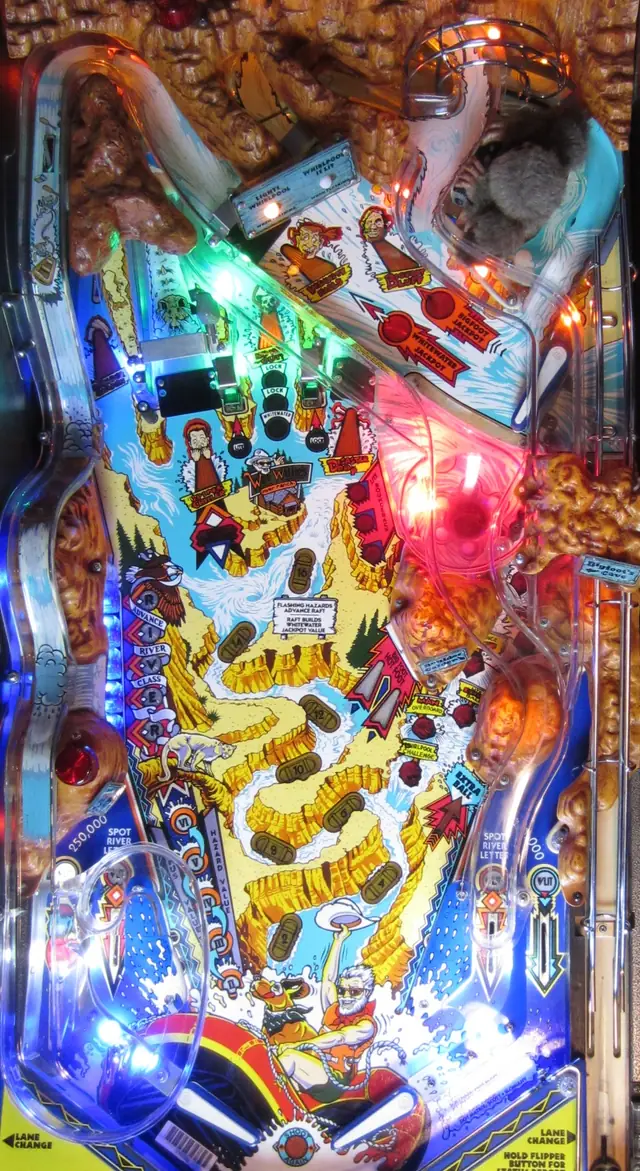
Silverball guide · White Water
Don't start multiball yet
Whitewater rewards shooting whatever is flashing, which is why most players never find its real scoring. The river is a ladder, and the jackpot waits at the top of it.
The river is a ladder
There are nine rafts: 2, 4, 6, 8, 10, 12, 14, 16 and Wet Willie's. You start on Raft 2 and climb by completing lit hazards, with the number required creeping up as you go — typically one, then two, two, three, three, four, four, five, five.
Advancing pays 1M times the raft you arrive at, which is pleasant. The reason to care is elsewhere: your raft number sets the base jackpot value for multiball, at 10M plus 1M per raft.
So the raft number is not a progress bar. It is the price tag on every jackpot you will collect later, and it is the single most important number on the machine.
Finish Wet Willie's and you go back to Raft 2, needing roughly two more hazards per raft than before — but every completed Wet Willie's adds another 20M to the base jackpot permanently.
Which is why you should not start multiball yet
This is the strategic heart of Whitewater and it runs against every instinct the machine encourages.
Because the jackpot is priced off your raft number, an early multiball collects cheap jackpots — and it spends the locks that get harder to light every subsequent time. You are trading an expensive future multiball for a cheap present one.
So for the first part of a game, deliberately avoid multiball. Climb rafts by collecting lit hazards, and work the whirlpool awards. Come back for multiball when the jackpot is worth having.
This is hard advice to follow, because locks light almost by accident and an uncollected lock nags at you. Ignore it.
No Way Out is the shot
If you learn one shot on this machine, learn No Way Out. You need it from either flipper, at any time, and often without looking at the ball — during multiball you will be shooting it while your attention is on the upper playfield.
Insanity Falls is second in importance and wants a firm slap on the flipper; the sweet spot is narrow and a soft shot will not make it. Bigfoot Bluff, the third of the important shots, is genuinely easy once you know where it is.
One practical warning: a solid backhand into No Way Out can rattle and drift back out. Wait for the sound or the display to confirm the lock before you relax. If it does come back down it usually arrives at the tip of the left flipper, where a gentle shot will put it away properly.
The whirlpool ladder
Six whirlpool awards come round in a fixed order: Whirlpool Challenge, Man Overboard, Light Extra Ball, Advance Raft, Mystery Canyon and 5X Playfield. Collect all six and the set resets, starting again at Whirlpool Challenge.
The mechanism is two shots. Shooting Insanity Falls when its yellow light is lit arms Bigfoot Bluff; shooting Bigfoot Bluff when its red light is lit collects whatever award is currently flashing. While the whirlpool is available, every jet bumper hit rotates which award that is — so the bumpers are a selector, not just noise.
Advance Raft is worth understanding properly: it behaves as though you collected every currently lit hazard, and it does pay the raft value. If Bigfoot Bluff happens to be your last required hazard, collecting Advance Raft there advances you two rafts at once.
And if you hit Insanity Falls at any point — even with the yellow light out — the whirlpool becomes available again as soon as whatever is currently running has finished.
Whirlpool Challenge is where the points actually are
The first award in the cycle is a two-ball multiball, and it is the biggest scoring opportunity on the machine by a distance. The sheet's author reports seeing 880M from a single Whirlpool Challenge.
The whirlpool starts lit at 5M and goes up 2M every time you hit it. Every sixth hit completes the whirlpool, which pays 20M, then 40M, 60M, 80M, up to a ceiling of 100M — and the value carries on climbing underneath regardless.
The way to milk it is control. Catch one ball on the left flipper and hold it, then work the other repeatedly between No Way Out and the whirlpool, catching the kickout from the Lost Mine each time and going again. You can also run both balls if you listen for the audio cue that tells you which feed is coming, but holding one is far more forgiving.
If you lose a ball before collecting anything, the whirlpool stays lit for a generous last chance at 5M. Take it.
In multiball, let the first ball go
The mistake is collecting regular jackpots. The prize is the double and triple jackpots, earned by getting the second and third balls up Insanity Falls.
So at the start of multiball, ignore any ball that has already come down Insanity Falls. Concentrate entirely on sending the next ones up it. You will very likely lose the first ball doing this, and that is the correct trade — thirty regular jackpots are worth less than getting to triple.
If you miss the first or second attempt at Insanity Falls, let that ball go rather than chasing it. It has almost no chance now and it is in the way of the balls coming from No Way Out. There is even an upside: shoot it straight into No Way Out and the machine may read it as a failed kickout, handing you another attempt at raising the jackpot.
The number of balls in play does not change the jackpot value, so there is nothing lost by playing this way.
Spend 5X playfield properly
5X Playfield is the last of the six whirlpool awards, and where you spend it matters more than getting it.
It is largely wasted on multiball. The good moments are Wet Willie's, or — the reliable one — when you have exactly one hazard left to advance to a high raft. Collected there it can be worth as much as 100M.
Bigfoot Hotfoot is also a fine thing to have running under 5X, so keep half an eye on how close you are to it. Nobody sensibly shoots for Hotfoot or Gold Rush on purpose; they arrive on their own if you play enough.
The extra ball target, and the drops
The extra ball target is very hard to hit and dangerous to attempt, and the hardest part is not hitting it but keeping control of the ball afterwards.
There is a sensible insurance policy: go for it during a multiball — regular, Whirlpool Challenge or Gold Rush — so that risking one ball is not risking your ball. There are several techniques, but the most reliable is holding the right flipper as the ball feeds from the upper playfield to the right inlane, letting it roll to the tip of the left flipper, which leaves it sitting perfectly for a straight shot.
Keep count of your Disaster Drops as well. There is an extra ball somewhere between three and fifteen of them, and drops spot hazards — which makes them the civilised way to deal with the awkward ones like the Spine Chiller and Boomerang Bend, and to nudge along one of the difficult late rafts.
Man Overboard follows the same logic in reverse: it pays out on the hazards that are currently lit, so collect it when the lit ones are easy rather than when they are not.
Where this came from
Silverball wrote this, but not from scratch: it was compiled against the published rules below and checked against them, rather than written up from one person’s games. None of the wording is theirs. Machines get code updates that move the right shot, so a guide has a date on it for a reason.
- Whitewater rule sheet, written and maintained by Kevin Martin