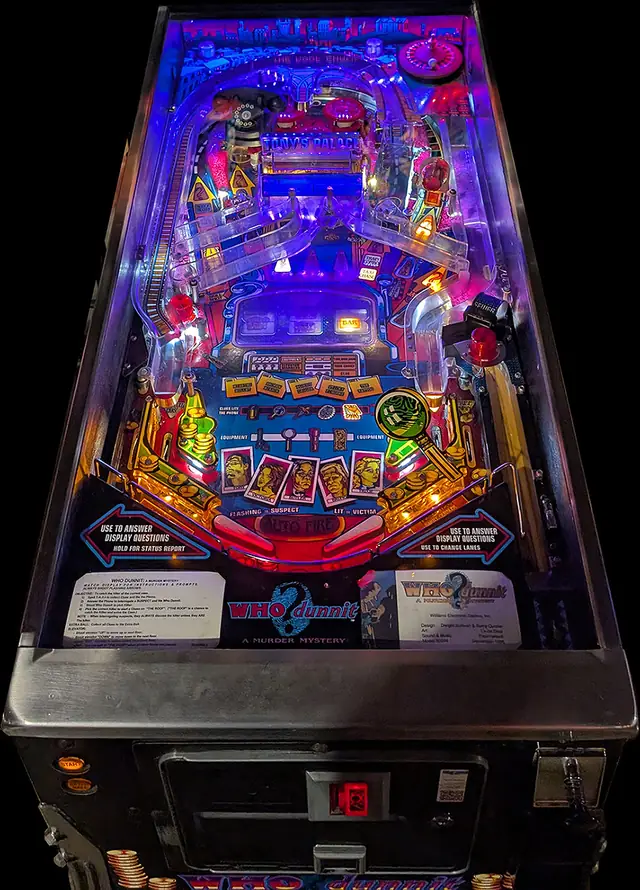
Silverball guide · WHO Dunnit
Do not catch the killer yet
Solving a case starts a new one, and a new case wipes your clues. Since five clues in a single case light an extra ball, the mystery is often worth leaving unsolved a while longer.
Clues reset, so time the solve
Clues come from spelling T-A-X-I, from the super skill shot and from three fingerprints on the slots. They climb to a maximum of 50 million, and five collected within a single case lights an extra ball.
Collected clues reset when a new case starts, and solving a case starts the next one. So catching the killer as soon as you can identify them throws away the clue count you were building. The source's own strategy section says it outright: if you have a number of clues, it may be better to keep collecting than to pick the right suspect.
There are five cases in a fixed order and none of them mean anything mechanically, so there is nothing lost by lingering in one. Failing to catch the killer is not fatal either; you move to the next case and can come back to this one later.
The suspects tell the truth, unless they did it
Interrogating is done by answering the phone when it rings, and a suspect answers a question for you. The rule underneath is the whole mystery: a suspect will always talk about the killer, unless they are the killer.
So a suspect who says nothing useful about anybody else has told you something very useful about themselves. Collecting a clue lights the telephone, which is the connection between the two halves of the game.
Choosing is done at the phone when WhoDunnit is lit. Get it right and Catch the Killer begins immediately, without needing to reach the roof.
Catch the Killer is where the points are
Reached by the roof, or by naming the right suspect. You must complete the lit Taxi Chase and then the phone, and taking too long makes the lit chase move or the phone go dark and send you back to a chase.
Once the phone is lit, a hurry-up starts at 100 million and falls to 25 million. Whatever value you catch the killer at is the number that matters, because the four-ball multiball that follows pays that value for every lit shot you hit. Catching the killer late is therefore worth a fraction of catching them early, even though both end the case.
Eleven floors, and what each is for
The elevator is the spine of the game. The basement is a three-ball multiball. The main floor lights slots and roulette. The second floor gives four Taxi letters, which is a clue outright, and lights the phone. The third and fifth each give evidence or a chance to name the killer. The fourth spins the slots. The sixth awards a piece of equipment. The seventh is Elevator Madness. The eighth interrogates a suspect or lets you name the killer.
The penthouse needs the penthouse key, and the roof needs either every other floor visited or a correct guess.
Equipment is quietly powerful and there are four pieces. The revolver makes bumper hits build multiball jackpots at 5 million instead of 1 million. The magnifying glass eliminates a suspect on a phone shot when nothing else is awarded. The flashlight finds the map, and the map makes the sewer pay real awards instead of small points.
The slots are more than a random award
Three bars pays 100 million. Three magnifying glasses gives equipment, three fingerprints a clue, three multiballs a multiball, three extra balls an extra ball, three jackpots a jackpot, three wilds the roof, three question marks Elevator Madness. A mismatch pays 5 million.
Two useful mechanics sit behind it. Every reel has a wild, and the middle reel's is a Wild Choice that lets you pick the left or right reel's award. And matching two of three gives you a second chance, collected by completing any spin shot.
That second chance is why a lit outlane is not a disaster. Draining through a lit outlane triggers the slots, and matching two gives you a second chance with an autolaunched ball, which the source calls a pseudo kickback. Multiball and Elevator Madness from the slots do the same job.
Penthouse Party and the bonus nobody counts
The source is blunt that the basement and the penthouse are the lucrative places. Penthouse Party lights every flashing shot for increasing values, 10 million, 20 million, 30 million and upward until the timer runs out, and it describes keeping the shots going as easy and worth around 750 million.
The end-of-ball bonus is the other thing worth playing for deliberately, because it is built from things you would otherwise treat as incidental: 5 million per case started, 1 million per clue, 5 million per slots spin, and 20 million per case finished, all multiplied. In a long game the source puts this above a billion.
Consecutive ramp shots build a train combo: the first lights roulette, the second gives the flashlight, the third lights an extra ball, and the fourth starts a run at the Loop Champion.
A note on this source
This was compiled from version 1.0 of Scott R. Tiesma's rule sheet, dated 2006. He permits the sheet to be distributed and copied freely on the condition that his name and its special thanks section are not removed or edited, so our credit names him; this guide is our own prose rather than a copy of his sheet, and his own document remains the place to read the people he thanks.
He also documents the machine's bugs as part of the rules, including a display that cannot show a billion during play and a mislabelled seventh floor. And he records that there is no wizard mode at all, which is worth knowing before you go looking for one.
Where this came from
Silverball wrote this, but not from scratch: it was compiled against the published rules below and checked against them, rather than written up from one person’s games. None of the wording is theirs. Machines get code updates that move the right shot, so a guide has a date on it for a reason.
- Who Dunnit? rule sheet, version 1.0, compiled by Scott R. Tiesma, 2006